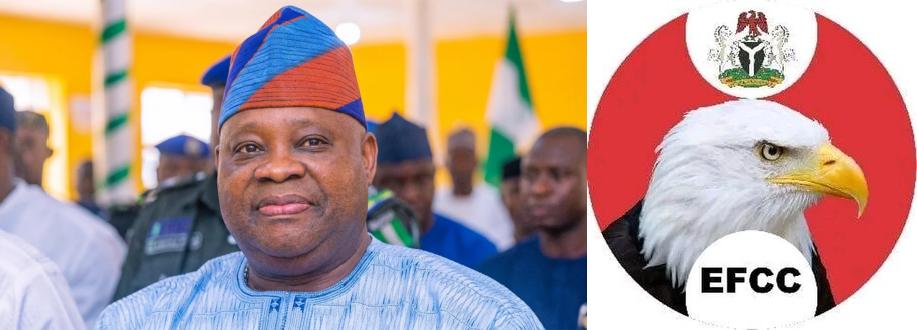
The Economic and Financial Crimes Commission (EFCC) has frozen an Osun State Government bank account domiciled with First Bank, barely 10 days before the state’s governorship election scheduled for August 15. A document obtained by Vanguard showed that the account, said to be used for paying workers’ salaries, was placed on a “Post No Debit” restriction (a bank order that blocks withdrawals or transfers from an account) by the anti-graft agency.
The development came hours after Governor Ademola Adeleke alleged that the EFCC was plotting to freeze the state government’s accounts, as well as those of senior officials. In a statement issued on Wednesday by the Commissioner for Information and Public Enlightenment, Kolapo Alimi, the governor described the move as politically motivated and aimed at disrupting government operations ahead of the election. Adeleke argued that the EFCC lacked the constitutional and statutory authority to freeze the accounts of a state government, insisting there was no legal justification for the action. A source close to the governor, speaking on condition of anonymity because they were not authorised to comment publicly, confirmed the restriction: “I can confirm that the state government account has been frozen by the EFCC. It is no longer an allegation.”
The EFCC later broke its silence, saying the action had nothing to do with the election. The commission said it had been investigating the Osun State Government since March 2026 over the alleged fraudulent handling of about N11 billion in Ecology Funds, Intervention Funds and Federation Account allocations, and that some state officials, including the Accountant General, had already been questioned. It said the investigation alone would not have justified freezing the account, but that it detected “precipitate and unwarranted movement of funds” into various corporate entities starting August 2, which it said forced it to act quickly to stop further transfers. The commission insisted it was “non-partisan and non-sectarian” and was simultaneously monitoring the finances of several other state governments, not just Osun’s.
Osun’s Attorney-General and Commissioner for Justice, Oluwole Jimi-Bada, said the governor had authorised him to challenge the freeze at the Federal High Court, arguing that while the EFCC can investigate a government’s accounts, it cannot freeze them without first securing a court order. The Accord Party, on whose platform Adeleke is seeking re-election, and the African Democratic Congress (ADC) both condemned the move, with Accord’s national chairman describing it as part of a “wider plot to use the police and federal agencies to capture Osun State” for the opposition All Progressives Congress (APC).
Not the First Flashpoint This Election Season
This is not the only clash between Osun’s government and federal security agencies in the run-up to the poll. Weeks earlier, police raided the residence of the Secretary to the State Government, Teslim Igbalaye, over allegations of vote-buying and harbouring a wanted suspect, arresting him and five others before he was later released. The state government and the ruling Accord Party accused security agencies of targeting officials, while sustained protests also led to the redeployment of the state’s police commissioner over allegations of partisanship.
The wider tension between the EFCC and state governments is not new either. Fifteen states once jointly challenged the constitutionality of the law establishing the EFCC at the Supreme Court, though the case was dismissed in November 2024. The commission has also pursued long-running, high-profile prosecutions of state-level officials, including a former Kogi State governor, over alleged financial misconduct while in office. Disputes over whether federal agencies act evenhandedly toward opposition-controlled states, or lean toward the party in power in Abuja, have recurred around elections for years, regardless of which party benefits at a given moment.
Why This Keeps Happening — and Who It Affects
The likely causes. Nigeria’s anti-graft agency has broad investigative powers and a legal mandate to move quickly when it suspects public funds are at risk, which can mean freezing accounts without waiting for the outcome of a full investigation. At the same time, Nigeria’s history of federal agencies being perceived as tools of the ruling party at the centre means any action against a state government, especially one led by an opposition party, is almost automatically read through a political lens, whatever the underlying facts.
The effects on the state and its workers. In the immediate term, a frozen salary account raises real concern for the roughly hundreds of thousands of Osun civil servants who depend on it, regardless of who is ultimately proven right about the EFCC’s motives.
The effect on Nigeria as a country. Cases like this test public confidence in two institutions at once: trust that anti-corruption agencies act on evidence rather than political convenience, and trust that state governments are truly accountable for how they spend public money. When the timing of an enforcement action lines up this closely with an election, it becomes harder for citizens, including those outside Osun, to separate genuine anti-corruption work from political interference — a credibility problem that outlasts any single election cycle.
What Could Help Resolve Disputes Like This
Judicial oversight before major freezes. Requiring a court order before an account as significant as a state salary account is frozen, as Osun’s Attorney-General is now arguing for, could reduce accusations of unilateral overreach.
Faster, evidence-based public disclosure. The EFCC explaining its reasoning only after the freeze had already caused public alarm gave room for rumour and political spin to dominate the story first.
An independent review mechanism for enforcement actions that fall within a defined window before elections, so that timing alone doesn’t become the central controversy.
Consistent standards applied to all states, regardless of the party in power, so that anti-corruption enforcement is not seen as selectively targeting the government’s political opponents.
Where we Stand on This
I don’t think it’s my place to declare who’s right here — whether the EFCC genuinely caught suspicious fund movement in real time, or whether the timing, 10 days before a hotly contested election, was itself the point. Both explanations are plausible, and only a transparent investigation and, if it comes to that, a court ruling will really settle it. What I do think is fair to say is that Nigeria keeps having this exact argument, election after election, precisely because neither side has done enough to build trust with the public: EFCC rarely explains its timing before the damage is done, and state governments rarely welcome scrutiny of public funds even when it’s legitimate. Until that changes, every freeze this close to a vote will keep looking like a political weapon to some and a necessary safeguard to others, and Osun voters deserve better than a story this murky ten days before they go to the polls.
Published by Ejoh Caleb