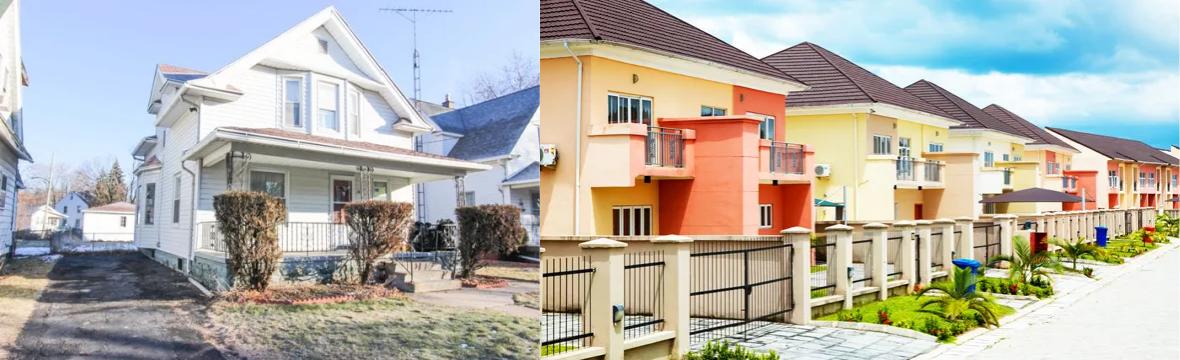
A Nigerian man based in the United States has sparked an online conversation after questioning why houses in Nigeria are not built the same way many American homes are. In a video, he pointed out that in the U.S., most houses are framed with wood before other materials are added, and in many cases, blocks or bricks are not used at all.
His comment taps into a long-running comparison between the concrete block construction most Nigerians are used to and the timber-frame method common in countries like the United States.
A Building Culture Built Around Concrete, For Better or Worse
In Nigeria, homes built from scratch are often treated as a major, once-in-a-lifetime family investment, and stories of Nigerians proudly showing off newly completed block or concrete houses regularly go viral online. But the same online space has also shown the darker side of how loosely regulated some construction can be, including one widely shared video of a building roofed with ordinary firewood in place of proper roofing timber, which left many viewers questioning building standards in the country.
Why Concrete Blocks Remain the Default Choice in Nigeria
Builders and engineers generally favour concrete blocks in Nigeria for a few practical reasons. Termites, which are common across much of the country, do not eat concrete, while wood-framed structures need consistent chemical treatment and maintenance to stay protected from pest damage. Concrete block homes are also seen as more resistant to Nigeria’s heavy rainy-season moisture and generally require less ongoing upkeep than timber-frame structures. On top of this, most Nigerian builders, tradesmen, and available building materials are set up around block work, meaning a switch to timber-frame construction would require new skills, new supply chains, and materials that are not widely produced locally.
Security concerns also play a role. With Nigeria’s relatively high rate of robbery and break-ins, many homeowners see solid concrete walls as a stronger physical barrier against intruders than a wood-framed structure, which can be easier to break through.
Wood framing is not without its own advantages, though. It is generally quicker and cheaper to construct with in places where the supply chain already exists, gives architects more design flexibility, and can offer better natural insulation.
What the Choice of Building Material Means for Homeowners and the Country
On a personal level, the heavy reliance on concrete blocks and cement adds significantly to the cost of building a home in Nigeria, since cement, sand, and blocks all require transportation and steady supply, and prices have risen sharply in recent years along with the naira’s depreciation.
On a national level, Nigerian engineers have been exploring whether local, sustainably sourced timber could reduce building costs and Nigeria’s carbon footprint, given that cement production is a major source of emissions worldwide. One academic study looked at using Opepe hardwood, a Nigerian timber species, as a lower-cost, more climate-friendly alternative to reinforced concrete for low-rise homes. Wider adoption of properly engineered local timber construction could, in theory, ease Nigeria’s housing deficit by lowering building costs, though it would require new training, regulation, and consumer trust to catch on.
Possible Paths Forward for Nigeria’s Construction Industry
Rather than a straight switch from blocks to wood, experts generally suggest a hybrid approach: using concrete or blocks for foundations and load-bearing structures where strength and pest resistance matter most, while exploring treated local timber for framing, roofing, and interior elements where it can cut costs. Investment in local timber treatment and quality-control standards would also help address the trust and durability concerns that currently make many Nigerians hesitant to build with wood.
Final Thoughts
I understand the appeal of the comparison in this video, an American-style timber-frame house does look faster and, on paper, cheaper to put up. But building methods usually exist for a reason tied to a place’s climate, pests, and available materials, not just tradition for tradition’s sake. The more useful question isn’t why Nigeria doesn’t build exactly like America, but whether Nigeria’s own local materials, like properly treated hardwood, could be engineered and regulated well enough to bring costs down without compromising the durability concrete currently offers.
Published by Ejoh Caleb