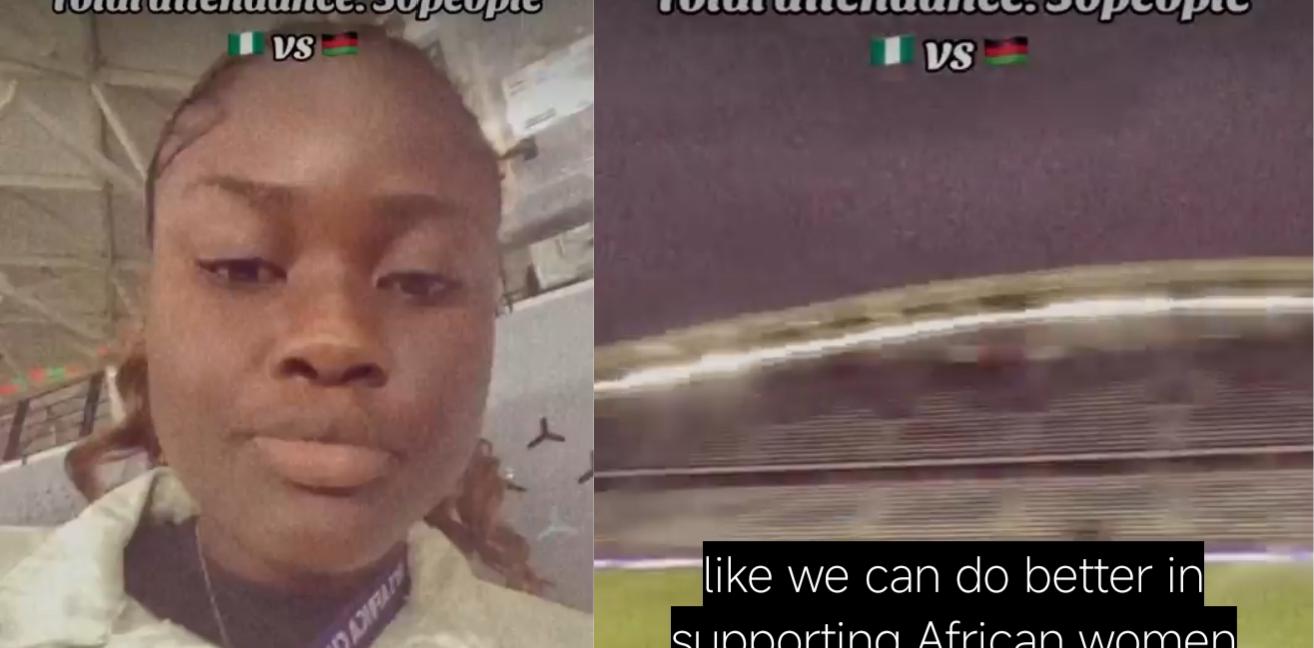
A Nigerian woman has criticised the poor turnout at the Super Falcons’ opening match at the ongoing WAFCON (Women’s Africa Cup of Nations, Africa’s top women’s football tournament) in Morocco. In a video that has been circulating online, she said, “We can actually do better in supporting women football… we’re not up to 30 in this stadium.”
Her comment came after Nigeria’s Super Falcons lost 3-2 to debutants Malawi on Tuesday at the Al Madina Stadium in Rabat, one of the biggest upsets in the tournament’s history. For a team that is Africa’s most successful women’s national side, with 10 continental titles, the sight of a half-empty stadium has again raised uncomfortable questions about how much Nigerians, and Africans generally, actually support women’s football.
This is not the first time WAFCON stadiums have looked empty
Low attendance at WAFCON matches is a recurring problem, not a one-off. At the 2024 edition, also held in Morocco, several seats stayed empty throughout the group stages and even the quarter-finals, despite the tournament being played across six stadiums for the first time. A recent analysis noted that capacity crowds would turn out for host nation Morocco’s matches, yet games involving strong teams like South Africa and Nigeria often played out in near-empty stadiums.
It has not always been this way. In 2022, a record 45,562 fans packed the Prince Moulay Abdellah Stadium in Rabat to watch a Morocco-Nigeria semi-final, still the largest crowd ever recorded at a women’s football match in Africa. That night proved big crowds are possible when conditions are right.
Why stadiums keep struggling to fill up
Several factors explain the low turnout:
High cost of travel: flying between African countries to support a team is often more expensive than flying to Europe, making it hard for fans to travel to away tournaments.
Visa and travel barriers: getting travel documents to enter host countries can be slow and complicated for fans from other African nations.
Weak promotion: past WAFCON tournaments have been criticised for poor local marketing and publicity, meaning even Moroccans do not always know when matches not involving their own team are happening.
Limited investment in women’s football: experts say the slow development of women’s football across Africa, stretching back to the tournament’s earliest years, has meant fewer resources go into building a fan culture around it.
Late kickoff times: this year’s Nigeria matches are scheduled for 9 p.m. local time, which can make it harder for families and casual fans in the host city to attend.
How this affects the players and the country
For the players, playing in a near-empty stadium after fighting for years to reach the top of African women’s football can be discouraging. Energy and atmosphere from fans often lift a team’s performance, and the absence of that support was visible during a match Nigeria was expected to win comfortably.
At the national level, poor attendance sends a damaging signal to sponsors and investors who might otherwise put money into women’s football in Nigeria. It also reflects a wider pattern: while European women’s football has grown into a mainstream product, with the 2025 Women’s Euro in Switzerland recording an average of more than 21,000 fans per game and a new aggregate attendance record of 657,291 fans across 31 matches, Africa’s biggest women’s football competition still struggles to convince its own fans to show up. That gap affects how seriously the sport is taken, and how much funding it can attract, on the continent.
What could help fill the stands
Cheaper, easier travel: African football bodies could push host countries to offer visa-free entry or fast-track visas for fans holding match tickets.
Stronger local marketing in host cities, so that even non-Nigerian fans know matches are happening and are encouraged to attend.
Brand-backed fan campaigns: companies like Amstel Malta have launched initiatives encouraging Nigerians to rally behind the Super Falcons through digital engagement and giveaways.
More free or subsidised broadcast access, so Nigerians who cannot travel to Morocco can still follow the team in large numbers, keeping public interest alive between matches.
Long-term investment in women’s football at home, so support for the national team grows out of a stronger domestic fan base rather than only appearing during major tournaments.
Our take
I understand that not everyone can afford to fly to Morocco to watch a football match, and that is a real barrier. But this goes beyond travel costs. It says something painful that a team with 10 African titles, more than any other country has ever won, can play a tournament opener to a stadium that is nearly empty. If we want the Super Falcons to keep winning, we cannot only celebrate them when they lift a trophy. Real support means showing up, or at least tuning in, when the team needs it most, not just when there is something to celebrate.
Published by Ejoh Caleb