By Ejoh Caleb | Visiotalks
Published: November 28, 2026
Key Takeaways
- The National Association of Nigerian Students (NANS) says it is targeting 10 million student votes for President Bola Tinubu’s re-election in 2027.
- NANS President Akinteye Afeez repeated the pledge on TVC News. The plan was first announced on October 14, 2026.
- Ten million would be about 40% of all votes cast in the 2023 presidential election, by our calculation.
- NANS says its support will not stop it from holding the government to account.
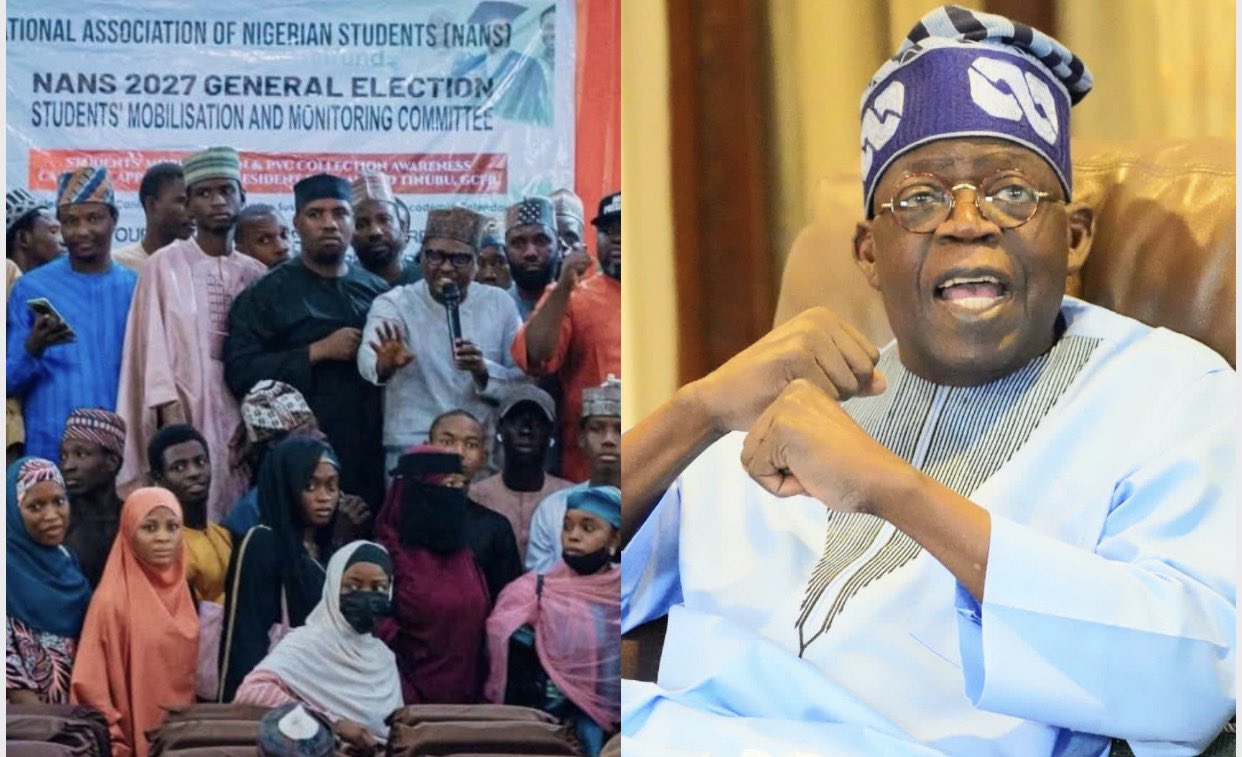
The National Association of Nigerian Students (NANS) says it will mobilise at least 10 million student votes for President Bola Tinubu’s re-election in the 2027 general elections. NANS President Comrade Akinteye Babatunde Afeez said so in an interview on TVC News’ “Beyond the Headlines”. He said the decision followed consultations with the association’s national and zonal leadership.
What NANS Said, Including the Plan to Act as One Voice and Still Hold Government to Account
Mr Afeez said NANS had set up a Nigerian Student Election Mobilisation Committee to encourage students to take part in the electoral process and to obtain their Permanent Voter Cards (PVCs). He said the association would use its Joint Campus Committee chairmen, zonal coordinators, national executives, faculty leaders and departmental representatives. He also insisted that NANS’s support for Mr Tinubu would not stop it from holding the administration accountable on issues affecting students.
When the pledge was first made, Mr Afeez said students would speak with one voice at the polls. He credited the government’s education policies and singled out the Nigerian Education Loan Fund (NELFUND), saying it had helped remove financial barriers to higher education. These are the association’s views. They are not independently verified, and not every student agrees with them.
Not a New Announcement: The Timeline From the Villa Meeting to the TV Interview
NANS first announced a “10 million” target in a statement on a Sunday in early October, saying its new National Election Mobilisation Committee would work to facilitate the participation of at least 10 million students. The statement also directed political support groups wanting to engage students to liaise with the committee.
On Wednesday, October 14, Mr Afeez led student leaders to meet Vice-President Kashim Shettima at the State House. There he declared that NANS would mobilise 10 million votes for Mr Tinubu’s re-election, across the six geopolitical zones. Mr Shettima told the students they must have a voice in national decisions. The TVC interview repeated the plan.
Checking the Numbers: How Big Is 10 Million Against Past Votes and Student Totals?
In the 2023 presidential election, 24,965,218 votes were cast. Mr Tinubu won with 8,794,726, and about 93.47 million voters were registered. By our own calculation, 10 million votes would be about 40 percent of all votes cast in 2023, and more than the winner’s whole 2023 total. The turnout in 2023 was about 27 percent of registered voters.
NANS says it represents more than 40.1 million Nigerian students. We found no official data supporting that figure. University data from 2018/19 show about 1.8 million undergraduates and 242,000 postgraduates. Polytechnics and colleges add more, and some students are under voting age, so the number of student voters is smaller than the number of students. We do not know how NANS counts students or how it would count votes.
Earlier Endorsement Rows and Leadership Disputes Inside the Student Body
NANS has had disputes over political endorsements before. In October 2022, NANS Southwest distanced itself from a “Tinubu/Shettima Students Vanguard” group. It said some people were collecting money from politicians with a promise to mobilise students to vote for them. In February 2023, NANS President Umar Barambu denied a report that NANS had endorsed Mr Tinubu, and said the association had not endorsed any candidate.
Leadership disputes have also split the body. In December 2023, two factions formed at a national convention, and Tribune reported that they later agreed to unite. A student-run commentary in 2025 criticised the leadership for taking part in partisan politics. That is an opinion piece. These cases show that endorsements can divide students, and that different leaders have taken different positions.
Loans, Campus Politics and Patronage: Forces Behind Student Endorsements
Student groups often support governments that offer them something concrete. Mr Afeez named the student loan scheme, which many students say eases the cost of study. Politicians also see students as a large and active group, and they court their leaders.
There are other pressures. Student unions depend on access to officials, and some leaders move on to political roles. The 2022 Southwest statement suggests that money from politicians can colour endorsements. We do not know whether this applies in the current case, and no one has alleged it here.
A Young Electorate’s Role in Nigeria’s Democracy and the Risk of Division
Young people’s participation matters for the country. Turnout in 2023 was only about 27 percent, so efforts to bring more people to vote, including students, could strengthen democracy. Encouraging students to obtain PVCs is a good goal whichever candidate they support.
But there is a risk when a national union picks a side. Students come from every part of the country and hold many views. A union that speaks for all but backs one candidate may leave some members feeling unrepresented. Reports say the final voter register is due to be published on December 15, so students should check whether they are registered.
Collective Voice Against Individual Choice: Weighing the Endorsement Fairly
NANS has a case. It is a representative body, and it can take positions on policy. Its leaders say the government’s education loan and efforts to reduce strikes serve students. Mr Shettima said students deserve a voice in national decisions. Students who agree will see the endorsement as a way to turn their numbers into influence.
There is also a case against. A vote is private and personal, and no union can deliver votes. Students who disagree, or who support other candidates, have the same rights. Critics might ask whether a body that relies on access to the government can fairly speak for all students. The pledge to keep holding the government to account will be judged by what NANS does when it disagrees with the government. Both views deserve a hearing.
Visiotalks Analysis: Five Questions to Ask About Any Bloc-Vote Pledge
- How is the number counted? “Participation” and “votes for a candidate” are different goals.
- Who are the students? Are they registered, of voting age and on campus?
- Who decides? Did members vote, or did leaders decide after consultation?
- What is promised in return? Pledges can be linked to policies, access or money. NANS says its support is based on policy.
- Can anyone deliver votes? The ballot is secret, and each voter chooses alone.
On these questions, NANS has said it consulted its national and zonal structures. We have not seen a vote of members, or the basis for the 10 million figure.
Frequently Asked Questions
Is this a new announcement? No. NANS first announced it in October and repeated it on TVC.
Is 10 million realistic? It would be about 40% of all votes cast in 2023, by our calculation. NANS has not explained how it will reach it.
Can students still get a PVC? We did not confirm. Check INEC’s schedule and the register.
Does NANS speak for all students? It is the largest national student body, but members hold different views.
Does support for Tinubu mean NANS will not criticise him? NANS says no.
Practical Steps for Students, Unions and Election Officials
Students can check whether they are registered and whether their PVC is ready. They can read each candidate’s plans on education, loans, strikes and jobs, and decide for themselves. Student unions can poll their members before taking positions and be open about how any pledge is funded.
INEC can state clearly what options students have, and where. Candidates of all parties can talk directly to students and address campus issues. Universities can host non-partisan debates where students hear from several sides.
Every Student’s Vote Belongs to the Student, Not the Union
We welcome any effort to bring more young people to the polls. Turnout was low in 2023, and students are among those who can change it.
But we also believe a vote is personal. A union can encourage, inform and advocate, and it can take a position on policy. It cannot promise the choices of millions of individuals. We hope NANS will explain its numbers, keep its promise to hold leaders to account, and respect students who think differently. Our democracy grows when young people choose freely, and when those who lead them respect that freedom.