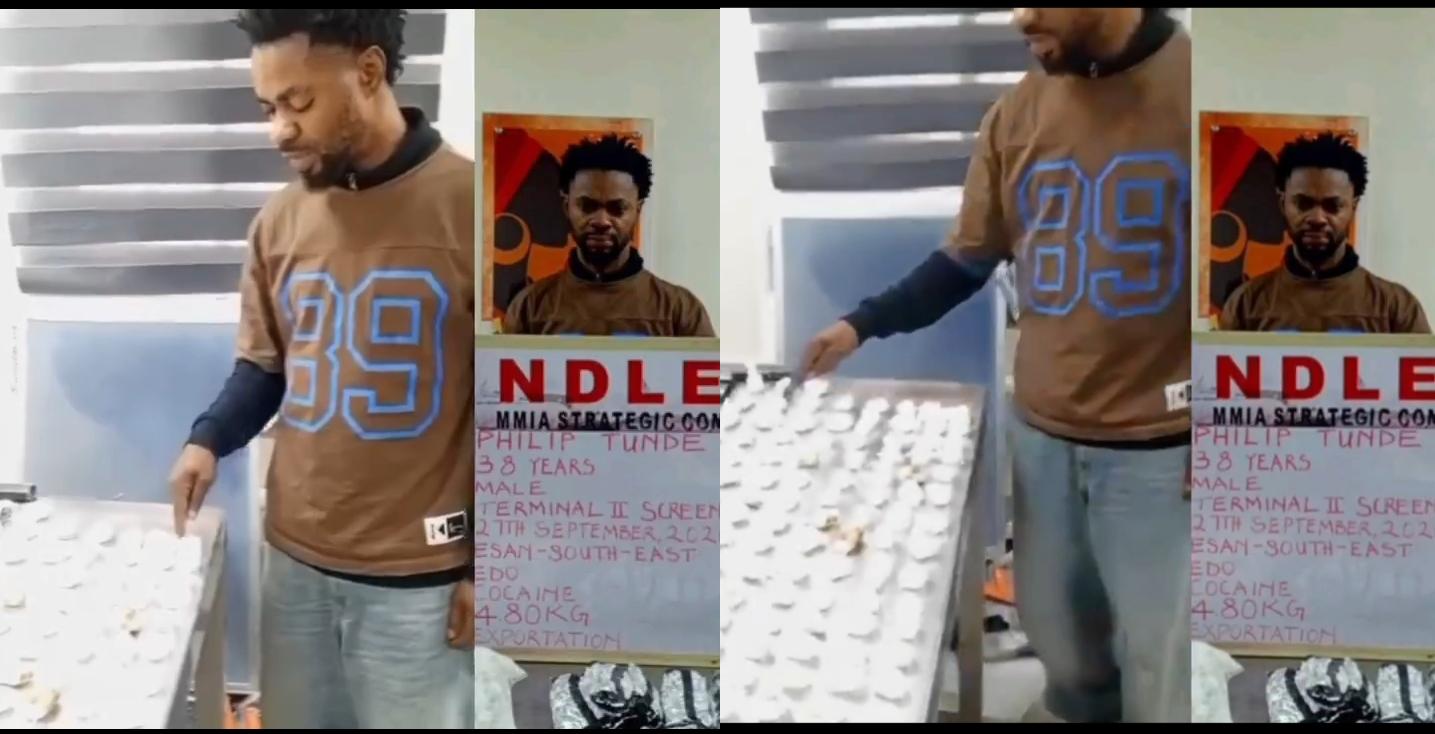
The National Drug Law Enforcement Agency (NDLEA) says it has stopped a 38-year-old businessman, Philip Tunde, with 4.80 kilogrammes of cocaine at the Murtala Muhammed International Airport (MMIA), Lagos. The drugs were hidden in the soles of shoes and in the railings of travelling bags. In a statement, Femi Babafemi, the agency’s Director of Media and Advocacy, said Tunde was arrested on Sunday, September 27, 2026. He was at the joint screening point of Terminal 2, getting ready to board a Royal Air Maroc flight to Milan, Italy.
How Everyday Travel Items Become Hiding Places for Hard Drugs (Cocaine Concealment)
The “joint screening point” is a checkpoint where officers from different agencies inspect passengers and bags together. According to the NDLEA, a thorough search there led officers to 16 parcels of white powder. They were hidden in the soles of eight pairs of trainers and canvas shoes. Officers also found 195 wraps of the same substance inside the railings of four travelling bags. The agency says the substances tested positive for cocaine and weighed 4.80kg in total.
The NDLEA also says Tunde told investigators he paid ₦16 million in cash for the cocaine in the shoes. He reportedly said the drugs in the bags were meant for delivery to a partner in Italy. These are claims made during questioning. They are not facts that a court has tested. Still, the amount shows how much money can be tied up in one small suitcase of drugs.
Repeated Tricks, Repeated Arrests: Lessons From Earlier Airport Cases
This is not the first time shoes have been used to hide drugs at the Lagos airport. In July 2024, the NDLEA arrested Francis Akajiobi, a 50-year-old Spain-based businessman, at Terminal 2. He had 1.20kg of cocaine in the soles of the sandals he was wearing. He was about to board a Royal Air Maroc flight to Madrid. The airline, the terminal and the hiding place were almost the same as in the new case. This suggests traffickers keep returning to methods they believe still work.
In June 2026, the agency arrested Abugu Oliver Ikechukwu, a 41-year-old Brazil-based businessman, at the same airport. The NDLEA said he brought in shirts and towels soaked in liquid cocaine, which were then dried and ironed. The total weight was 6.10kg. This case shows that traffickers can hide drugs inside the cloth itself, not just in shoes.
In December 2024, the NDLEA arrested another businessman, Olisaka Chibuzo Calistus, at the Kano airport. He had 256 wraps of cocaine weighing 6kg. The agency called it the largest cocaine seizure at that airport since its Kano command was created in 2006. The case proved that smuggling is not limited to Lagos.
A bigger case came in October 2024. The NDLEA said it stopped an international syndicate (a organised criminal group) from bringing 18.72kg of cocaine, in 845 wraps, into Lagos. The agency said couriers swallowed the drugs in Brazil and excreted them in Addis Ababa, Ethiopia. Other members of the group then tried to move the drugs into Nigeria.
What Is Alleged, and What Is Not Yet Proven (Presumption of Innocence)
Tunde has been arrested. He has not been convicted. The NDLEA says investigations are continuing. Under the “presumption of innocence” (the rule that a person is innocent until a court proves guilt), he remains a suspect for now. The claim about the ₦16 million and the “partner in Italy” came from his interview with the NDLEA. Those details still need to be tested in court.
Readers should also note that a few outlets reported his age as 28. The NDLEA statement carried by most outlets says 38.
Quick Money, Foreign Demand and Hidden Networks: The Forces Behind Drug Couriers (Mules and Middlemen)
Cocaine is not made in Nigeria. It comes mostly from South America. The United Nations Office on Drugs and Crime (UNODC) says Nigerian groups are known for moving small amounts of cocaine on passenger flights, using couriers called “mules.” Its World Drug Report 2022 also says Africa’s role as a stopover for cocaine heading to Europe has grown since 2019.
Another UNODC study says Nigerian networks use couriers to carry small amounts on commercial flights, often through Brazil. From Lagos, more couriers then spread the drugs to other parts of Africa, Asia and Europe. The reasons are simple. Demand in Europe is high, profits are large, and some people are tempted by fast money. Smugglers also know that a well-dressed “businessman” with a normal ticket may draw less suspicion than other travellers.
UNODC has also said the amount of cocaine that actually passes through Nigeria may be only a modest share of what reaches West and Central Africa. So the problem is serious, but it should not be exaggerated.
The Damage to People, Families and the Nation’s Name
For the individual, the cost is heavy. A convicted trafficker can lose years of freedom and his savings. His family can lose its main earner and its good name. Anyone who uses the drug can suffer harm to health and may become dependent on it.
The harm also reaches the whole country. Every arrest of a Nigerian traveller with drugs adds to a bad image abroad. Honest Nigerian travellers, students and traders can face extra suspicion at foreign airports. The government also spends money on investigations, courts and prisons. Criminal money from drugs can corrupt officials and fuel other crimes. A country that is seen as a drug route will find it harder to build trust with foreign partners and investors.
Smarter Checks, Shared Intelligence and Real Opportunities: Ways to Close the Door on Smuggling
Airport checks must keep improving. Better scanners and trained officers matter, but so do intelligence tips and cooperation with airlines. The NDLEA’s use of watch-lists and joint examinations with other agencies has already helped it catch many consignments. Nigeria should also work closely with destination countries such as Italy so that buyers and partners abroad are tracked, not just carriers.
Following the money is just as important. A ₦16 million cash payment, if true, is the kind of trail that financial investigators should be able to follow. Fast and fair prosecution would also show would-be traffickers that arrests lead to real consequences.
Prevention matters too. The same NDLEA statement mentioned school sensitisation visits (awareness talks for students) in Ado Ekiti and Lokoja. Such work should reach young people early, together with honest job and training chances, so that crime does not look like the only way to earn quick money.
A Closing Reflection on Greed, Trust and Border Watchfulness
We believe this case is a warning to all of us. It shows that drug smuggling can look ordinary. It can wear a business suit, carry a normal passport and pack clean trainers. It also shows that officers can still catch it when they stay alert and share information.
We also believe the story should not end at the airport gate. A courier who is caught is only one link in a long chain. If the buyers, financiers and partners are not traced and punished, new couriers will keep appearing. Nigeria cannot afford to be known as an easy road for hard drugs. We therefore urge the authorities to follow this case to the end, and we urge families to speak to loved ones before a “quick business trip” turns into a prison sentence.
Published by Ejoh Caleb