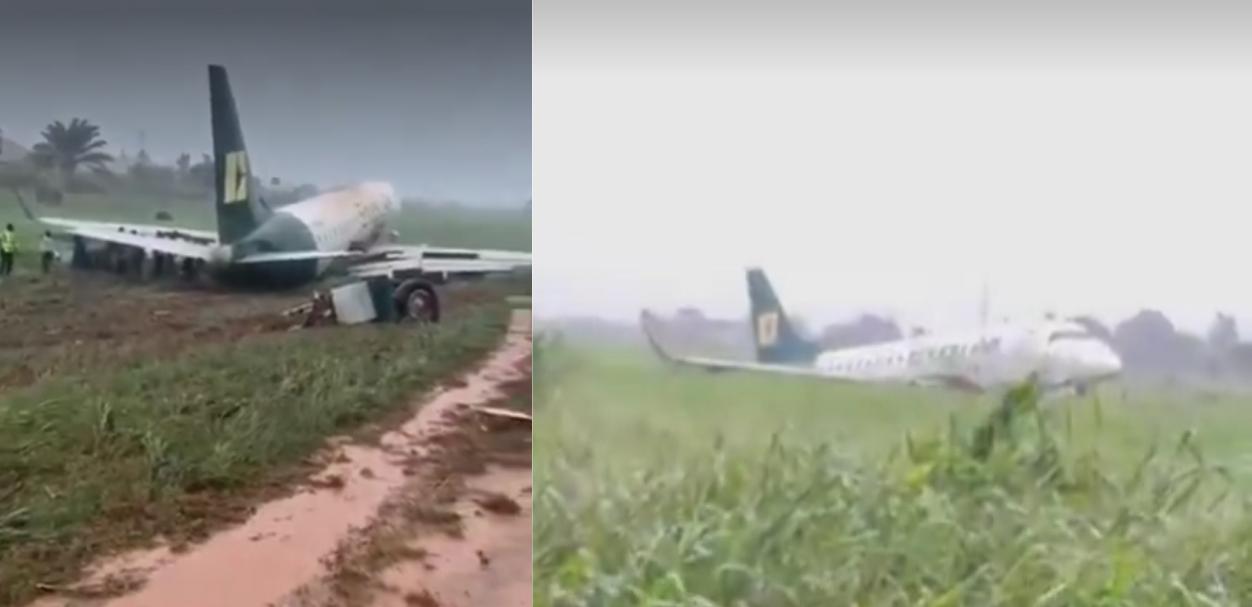
An Enugu Air plane skidded off the runway while landing at the Benin Airport on Thursday, July 23, 2026, sending panic through the aircraft and triggering an emergency response. The plane, an Embraer E170 jet operating as Flight 4264 from Lagos, ran past the end of Runway 05 at about 3:10 p.m. and came to a stop in the bush beside the airport.
There were 63 passengers and five crew members on board — 68 people in total. Everyone got out safely. No one was injured.
Enugu Air, which is owned by Enugu State, confirmed the incident in a statement on its X account. The airline said the aircraft has been secured, and that aviation authorities have been told. It warned that some flights may be delayed or changed because of the incident.
The Nigerian Safety Investigation Bureau (NSIB), the government body that investigates air accidents, has sent a team to Benin to find out what went wrong. Investigators are talking to the pilots, checking the plane, and looking at the state of the runway.
This Is Not the First Time — A Pattern of Planes Running Off Nigerian Runways
This kind of incident has happened again and again in Nigeria in the last few years.
In July 2025, an Air Peace Boeing 737 skidded off the runway at Port Harcourt Airport.
In May 2024, an XE Jet plane veered off the runway at Lagos airport during heavy rain, sliding onto soft ground. All 52 people on board were unhurt.
In December 2024, a Max Air plane lost a landing gear tyre while landing in Kano and skidded along the runway. That same month, a cargo plane skidded off the runway in Abuja. And a year before that, in November 2023, another plane veered off the same Abuja runway in a strikingly similar incident.
Going further back, a Nigeria Airways plane overran the runway in Abuja in 1983, after the pilots misjudged how much runway they needed.
In nearly every one of these cases, the story ends the same way: passengers walk away shaken but alive. But experts warn that this string of near-misses cannot continue forever without a real tragedy.
When It Has Gone Wrong Before — Nigeria’s History of Deadly Plane Crashes
Not every incident in Nigerian aviation history has ended without loss of life. Nigeria has recorded several fatal plane crashes over the decades, and they are part of why every new runway incident, even one with no deaths, still worries the public.
On June 3, 2012, a Dana Air flight from Abuja to Lagos lost power in both engines and crashed into a crowded neighbourhood in Lagos. All 153 people on board died, along with several people on the ground.
On October 29, 2006, an Aviation Development Corporation (ADC) Boeing 737 crashed shortly after takeoff from Abuja, killing 96 people on board, including a prominent Muslim religious leader.
On December 10, 2005, a Sosoliso Airlines plane crash-landed at Port Harcourt Airport in bad weather and caught fire, killing 108 of the 110 people on board. Most of the victims were schoolchildren travelling home for the Christmas holiday.
Just weeks earlier, on October 22, 2005, a Bellview Airlines plane crashed minutes after taking off from Lagos, killing all 117 people on board.
On May 4, 2002, an EAS Airlines plane crashed into a crowded neighbourhood in Kano shortly after takeoff, killing most of the 77 people on board along with dozens more people on the ground.
Further back, on November 20, 1969, a Nigeria Airways plane crashed while landing in Lagos, killing all 87 people on board.
These crashes are why aviation safety is treated as such a serious matter in Nigeria. A runway excursion like Thursday’s incident in Benin looks minor by comparison, but it involves the same aircraft, airports, and safety systems that have failed catastrophically before.
Why Planes Keep Skidding Off Runways in Nigeria
There is no single cause. Aviation experts point to several factors that often combine to cause a runway excursion.
Heavy rain is one of the biggest culprits. When rain sits on a runway, it can cause hydroplaning (also called aquaplaning) — this is when a layer of water builds up under the plane’s tyres, so the tyres lose grip on the ground. The pilot cannot brake or steer properly, and the plane keeps sliding forward. Thursday’s incident in Benin happened during rainfall, matching a pattern seen in several past cases.
Other causes named by pilots and safety experts include a dirty or damaged runway surface, mechanical problems such as brake or tyre failure, pilot error, and an unstable approach — where the plane comes in too fast, too high, or off-course before landing.
Nigeria’s aviation sector has also long struggled with old aircraft, an industry-wide shortage of experienced pilots, and criticism that the regulator, the Nigerian Civil Aviation Authority (NCAA), has not enforced safety rules strictly enough.
How These Incidents Affect Nigeria, Not Just the Passengers Involved
For the passengers on board, an incident like this is terrifying, even when no one is hurt. Many walk away shaken, and some may avoid flying that route again.
For the airline, each incident costs money — the aircraft has to be inspected and repaired, flights get delayed or cancelled, and the airline’s reputation takes a hit. This matters even more for Enugu Air, a young airline that only began flying in July 2025, less than a year before this incident.
But the effect goes beyond one airline. Every time a Nigerian-registered plane skids off a runway, it adds to global concern about the safety of flying in Nigeria. This can scare off foreign airlines, investors, and tourists, and make it harder for Nigeria’s aviation industry to grow. It also puts pressure on the federal government and the NCAA, who are meant to be responsible for keeping the skies and runways safe for everyone. Each new incident makes it harder to convince the world that Nigeria has fixed its aviation safety problems.
What Can Be Done to Stop This From Happening Again
Aviation experts and past investigation reports have repeatedly pointed to the same fixes:
Airports need better drainage and regularly grooved runways, so rainwater does not build up and cause hydroplaning.
Airlines need stricter maintenance schedules, especially for older aircraft still flying in Nigeria.
Pilots need regular retraining on how to handle bad weather landings and unstable approaches.
The NCAA needs to enforce safety rules more strictly and punish airlines that cut corners.
The NSIB should publish its full investigation reports quickly and publicly, so lessons are actually learned and acted on, not just filed away.
Our Take
I do not think it is a coincidence that this keeps happening. When the same type of incident repeats itself year after year, in different cities, with different airlines, it stops being bad luck and starts looking like a pattern the country has failed to fix. Nigeria has been fortunate that none of these recent runway excursions have cost a single life. But luck is not a safety strategy. If the government and the airlines do not treat every one of these near-misses as a warning, I fear it is only a matter of time before we are not writing about a safe evacuation, but a funeral.
Published by Ejoh Caleb