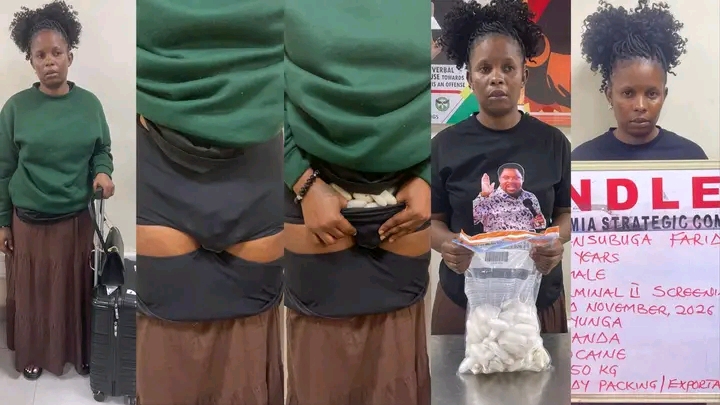
The National Drug Law Enforcement Agency (NDLEA) has arrested a 34-year-old Ugandan woman, Farida Nansubuga, for allegedly trying to smuggle 1.15 kilogrammes of cocaine from Nigeria to Uganda. Officers arrested her on Tuesday, November 3, 2026, at the Murtala Muhammed International Airport (MMIA), Ikeja, Lagos, as she prepared to board a flight home.
NDLEA said she was stopped at the screening point of Terminal 2 during a joint screening with aviation security staff. A search found 87 wraps of cocaine strapped around her pelvic region beneath two layers of underwear.
What the Agency Says She Told Investigators (A Preliminary Interview Is Early Questioning That Can Later Change)
According to NDLEA spokesman Femi Babafemi, Nansubuga said she arrived in Nigeria on October 29 with members of her church for a prayer session at the Synagogue Church of All Nations (SCOAN), Ikotun-Egbe, Lagos. The rest of her delegation returned to Uganda after the session, but she stayed behind to collect the cocaine for a friend named Joy, who lives in Uganda.
She reportedly said Joy connected her with a contact in Nigeria who arranged a vehicle to take her to a hotel on the morning of her departure. There, an unidentified man allegedly handed her the cocaine and told her to hide it under her clothing to avoid airport screening. She said no payment was agreed, but she expected at least $1,000 after delivering the drugs in Uganda.
These are her statements to investigators. The agency has not said whether Joy or the man at the hotel has been found, and it has not said whether she has been charged. She is entitled to a fair hearing, and we have not heard from her lawyer. The reports do not accuse the church or her fellow worshippers of any wrongdoing.
The Agency’s Warning: Faith Travel as Cover for Couriers (A Courier Is Someone Who Carries Illegal Goods for Others)
NDLEA’s chairman, retired Brigadier-General Mohamed Buba Marwa, described the case as a reminder that drug cartels exploit religious activities and cross-border travel to recruit couriers. He commended officers who made arrests and seizures across several states.
The same weekend, NDLEA reported other airport finds. Officers intercepted 750,000 tablets of Tapentadol 250mg, valued at ₦900 million, in a consignment from India declared as paracetamol. That seizure is separate from the Ugandan woman’s case, but it shows the range of smuggling attempts at the airport.
A Familiar Story at Nigerian Airports: Earlier Courier Arrests Involving Women
NDLEA has arrested other women accused of acting as couriers. In May 2025, it arrested a woman at Port Harcourt International Airport over an alleged attempt to smuggle 2.523 kilogrammes of cocaine to Iran.
In December 2025, the agency arrested a woman it described as a drug kingpin, with 23.50 kilogrammes of cocaine recovered from her children’s room in Lagos. NDLEA said she admitted owning the consignment, which it valued at over ₦5 billion. It linked the arrest to a cartel led by a couple that was broken up in May 2024. These cases differ in scale and role, but each shows women involved at different levels of the trade.
How Couriers Get Recruited: Small Promises, Big Risks and Hidden Bosses (Recruitment Means Persuading Someone to Join an Illegal Operation)
According to her own account, the woman expected a modest reward and had no clear payment agreement. That pattern is common in courier cases. Organisers often offer a small sum or a favour to a friend or acquaintance, and they keep their identities hidden. The courier takes nearly all the risk.
Travel for worship, weddings or business can make such trips look ordinary. A group movement may draw less suspicion than a lone traveller. We do not know whether Nansubuga knew her friend’s plan from the start, or whether she was pressed into it. The investigation should answer that.
What the Drug Trade Costs: Harm to Users, Couriers and Nigeria’s Name
Cocaine harms the people who use it and the communities where it is sold. Couriers face long prison terms, far from home, while the organisers often stay free. Families lose parents, sisters and friends to the criminal justice system.
For Nigeria, each case damages the country’s reputation as a transit point for drugs. It adds pressure on airports, the agency and partner governments. It also raises costs for honest travellers, who face tighter checks. A country that is seen as weak on trafficking risks tougher treatment from other states.
A Careful Look at Faith Groups and Trafficking: Avoiding Blame Without Ignoring Risk
It is important not to blame churches or worshippers for what one person is accused of doing. Many thousands travel for prayer every year without any link to crime, and the reports name no wrongdoing by SCOAN or by the rest of her delegation.
At the same time, the agency’s warning has a basis in what the suspect said. Faith groups can protect their members by teaching them never to carry packages for others, and by reminding them that a friend’s request is no excuse. Organisers of group trips can also remind pilgrims to pack their own bags and refuse parcels.
Closing the Gaps: Airport Checks, Cross-Border Cooperation and Public Warnings
NDLEA’s work at the airport shows that screening can catch concealed drugs. Continued joint checks with aviation security can keep up the pressure. Cooperation with Uganda’s authorities may help trace “Joy” and others in the chain, if the facts support it.
The public can help too. Anyone asked to carry a bag, package or gift across a border by someone they barely know should refuse and, if needed, tell the authorities. Churches, travel agents and hotels can display NDLEA warnings, and the agency can publish clear information in plain language about the penalties.
A Warning Wrapped in a Prayer Trip: Our Reading of One Arrest
We do not decide Ms Nansubuga’s guilt. She has made statements to investigators, and a court must weigh the evidence. We also note that the agency’s account names two unidentified people, the friend and the man at the hotel, who may be more important to the trade than she is.
We urge NDLEA to follow those leads and to say whether others will face charges. We urge travellers to guard their bags and refuse favours that sound simple. And we urge faith leaders to remind their members that a trusted friend’s request is still a risk. A journey meant for prayer should never end at a police desk.
Published by Ejoh Caleb