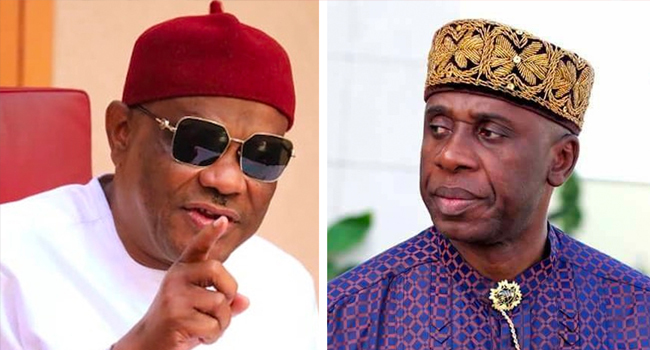
Nyesom Wike, the Minister of the Federal Capital Territory (FCT), has sharply criticised Rotimi Amaechi over a remark Amaechi reportedly made about voters who back President Bola Tinubu. Wike spoke to journalists in Abuja on Friday, October 9, 2026, after meeting the FCT area council chairmen.
Amaechi, who is described in some reports as the vice-presidential candidate of the African Democratic Congress (ADC), reportedly said at a party town hall in Benin City on Thursday that only mad people and thieves would vote for Tinubu in 2027. We have not seen the full remarks, and we found no response from Amaechi to Wike’s reply. Other outlets describe him as an ADC chieftain, so his exact role should be checked.
What Wike said in reply (the exchange)
Wike said: “A lunatic cannot preside over the affairs of this country! He said those who want to vote for Tinubu are thieves. So, I’m a thief? But who can be a bigger thief than Amaechi?” He added that Amaechi would struggle to campaign in Rivers State if he kept insulting the President’s supporters: “You cannot sit down, call voters madmen and thieves, and expect to walk away free.” Another report quotes him as saying “We will make it difficult for him.”
Wike also urged the Independent National Electoral Commission (INEC) and security agencies to sanction Amaechi over what he called irresponsible and inciting remarks. One outlet also quotes him calling Amaechi “a known armed robber.” No evidence for that was reported, and Amaechi has not been convicted of any crime.
Allegations Wike made about Amaechi’s time as governor (claims that need checking)
Wike criticised a ₦68 billion Port Harcourt monorail project that he said was abandoned during Amaechi’s tenure as Rivers State governor. He also alleged that $308 million from the sale of state-owned gas turbines was misappropriated, and said Amaechi was indicted by a judicial panel of inquiry and lost an appeal at the Supreme Court. The Voice of Nigeria noted that these claims require independent verification, and that Amaechi’s response was not included.
The court record is more complicated than a simple “indictment.” In 2022, the Supreme Court dismissed Amaechi’s appeal against the Rivers State judicial commission of inquiry, the panel headed by Justice George Omereji that Wike set up in 2015 to look into the sale of state assets. The court said the commission could only investigate and had no power to convict anyone. Both men then claimed the ruling as a victory. Amaechi’s media office said the court had made clear that he was not on trial and that the ruling cleared him of any indictment. Amaechi has long called the panel a witch-hunt arising from his political differences with Wike.
We found no conviction of Amaechi in any of these matters, and the allegations remain allegations.
A feud with a long history (past cases and where it stands)
The two men were once political allies in Rivers State. After Wike succeeded Amaechi as governor in 2015, the relationship broke down, and the judicial panel became one of the main points of conflict. That dispute has now moved into the national campaign. Wike earlier pledged to resign as minister if Tinubu loses both the FCT and Rivers State in 2027. That makes Rivers a high-stakes contest for him, and it helps explain the tone.
Two kinds of language to be careful about (insults and mental illness)
Both men are reported to have used words that stigmatise mental illness. “Mad” and “lunatic” are used as insults, and Wike also asked who Amaechi’s “psychiatric doctor” is. These words can hurt people who live with mental health conditions, and they do nothing to answer the political questions at stake. The reported threat to make campaigning “difficult” in Rivers also raises a question about every candidate’s right to campaign freely, which the law protects.
Campaign heat and personal rivalry (why the exchange turned so sharp)
Several things have combined. The 2027 campaign has begun to heat up, and Rivers is a key state for both sides. Wike and Amaechi have a personal history, and each can claim the other has a record to answer for. Remarks made at a town hall can go viral within hours, and a reply on camera attracts attention. The Presidency has also reportedly dismissed Amaechi as having no electoral value.
Tension, trust and risk in Rivers (effects)
Name-calling can harden political divisions. A threat to make campaigning difficult, even if meant as a political warning, could be read by supporters as a signal to disrupt events. Rivers State has a record of tense elections, so such language carries risk.
For voters, the exchange takes attention away from the issues. For the country, repeated insults weaken the standard of public debate and reduce trust in political leaders.
Keeping the contest on the issues (possible solutions)
Politicians on all sides can drop insults and answer questions about roads, security, jobs and prices. Parties can set and enforce codes of conduct, and INEC and the police can remind everyone that every candidate has the right to campaign anywhere in the country, and that violence or intimidation will be dealt with. If a candidate believes a rival has broken the electoral rules, the proper route is a complaint to INEC or a court.
On corruption claims, anyone with evidence of wrongdoing can pass it to the anti-corruption agencies or the courts. Media houses can help by checking claims and reporting both sides, including what the 2022 court ruling did and did not say.
Allegations are not verdicts, and insults are not arguments (our view)
We do not take sides in this exchange. Amaechi’s reported remark about voters was insulting, and Wike’s reply was equally harsh. Millions of Nigerians will vote for each candidate, and they should not be called thieves or mad by anyone.
On the corruption claims, the facts are more limited than the shouting. A commission was set up, a court said it could only investigate, and both men claim vindication. No court has convicted Amaechi, and no court has cleared up the questions Wike raises about the monorail or the turbine sale. If those questions matter to voters, they deserve answers in proper forums. And if candidates wish to be trusted with the country, they should show it first by how they speak about the people they ask to vote for them.
Published by Ejoh Caleb