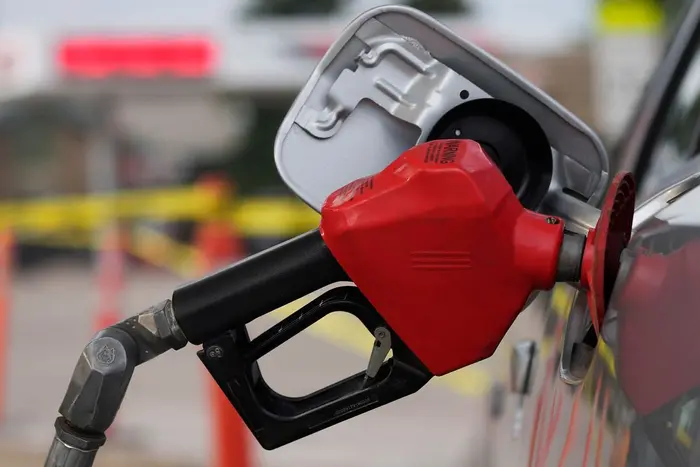
The Federal Government has announced a 30-day discount on petrol sold at stations of the Nigerian National Petroleum Company (NNPC) Limited, with public transporters given priority nationwide. The Minister of Finance and Coordinating Minister of the Economy, Taiwo Oyedele, announced it at a press conference in Abuja on Thursday, October 8, 2026. “It’s not a subsidy,” he said. “Government is just saying we sell to you at cost.”
The ₦1,350 figure needs care. The minister said the government is negotiating a ceiling of ₦1,350 per litre on the ex-gantry or landing cost of petrol. The ex-gantry price is the price at the depot or loading point, before transport and retail costs. The landing cost is the cost of bringing imported fuel into the country. He said it does not mean petrol will necessarily sell at ₦1,350 at every filling station. Some reports describe ₦1,350 as the pump price, so the exact meaning should be checked.
How the plan is meant to work (what officials say)
The government says it is not paying money to make petrol cheaper. It says NNPC Retail is cutting its own profit margin, which is the retailer’s share of the price on each litre. NNPC Retail buys petrol from the Dangote Refinery and other suppliers at market prices, then adds its margin. Oyedele said the margin is less than 5 per cent of the pump price, and that the cut is paid for through that margin alone. Pulse reported that there is no single fixed pump price for all NNPC stations, so actual prices may vary with supply costs.
The presidential spokesman, Bayo Onanuga, said that if NNPC’s landing cost is ₦1,300, it will sell to Nigerians, especially commercial vehicles, at that price. According to NNPC’s price list, petrol sold for ₦1,355 per litre in Lagos and Rivers and ₦1,370 in Abuja, down from ₦1,420 to ₦1,450 before recent cuts. Those reductions followed the Dangote refinery’s cut in its gantry price. The same report says the discount has been running since October 1.
The package also includes a plan for a national strategic fuel reserve, expanded use of compressed natural gas (CNG) in transport, tax and duty waivers on petrol, and removal of unlawful charges that raise transport costs.
What is still unclear (open questions)
The reports do not say how many NNPC stations will take part, which transporters qualify, or how drivers will prove it. They also do not say how much a motorist will save per litre. Critics also ask whether transport operators will pass any savings to passengers through lower fares, and what happens on day 31. The discount applies only to NNPC outlets, which are a fraction of the market, and does not set one national pump price.
Opposition reactions and the government’s reply (the political argument)
The announcement comes as Nigeria prepares for elections, and opposition parties have criticised it. Former Vice-President Atiku Abubakar called it a temporary political fix and said Nigerians cannot be expected to see a one-month discount as a solution to a crisis that will remain after it expires. He also noted that the government has not said how much motorists will save or guaranteed that fares will fall.
The Nigeria Democratic Congress, whose presidential contender is Peter Obi, described the measures as an attempt to bring back the petrol subsidy “through the backdoor.” Other statements called it a “Greek gift” and asked why Nigerians were left to bear high prices for more than 800 days. The Presidency’s position is that none of the measures restores a blanket subsidy, and that the intervention gives temporary relief while keeping market-based pricing. These are positions taken by parties and the government in an election season, and readers can weigh them against the figures below.
How prices got here (the record since 2023)
When President Bola Tinubu announced in May 2023 that the subsidy was gone, NNPC adjusted pump prices to between ₦488 and ₦557 per litre, from about ₦189 to ₦199. By April 2026, the National Bureau of Statistics reported an average retail price of ₦1,532.93 per litre, up 23.69 per cent from a year earlier. Diesel rose from ₦1,722.45 to ₦2,474.69.
The cost has reached commuters. The average intra-city bus fare was ₦1,431.25 in May 2026, up 38.63 per cent from May 2025. The government says subsidy removal saved ₦15.8 trillion between June 2023 and December 2025, with ₦5.4 trillion going to the Federal Government and ₦10.4 trillion shared among states and local governments. Onanuga also said that where CNG buses operate, fares have fallen by 30 to 50 per cent.
Global prices, the naira and the market (what drives the cost)
The government blames the recent pressure on higher global crude oil prices. Oyedele argued that without subsidy removal in 2023, those increases would have placed an even greater strain on the country. Since the market is now deregulated, local prices follow global crude prices and the exchange rate. That is why the minister said pump prices should not have to follow every swing in crude or exchange rates. Competition from the Dangote refinery has also pushed some prices down, and one analysis said NNPC’s cut reflects that competition as much as policy.
Who could gain and who may be left out (effects)
If transport operators pass on savings, commuters could see lower fares, and traders could see smaller cost increases for goods. A Channels Television analysis said that relief aimed at buses, taxis and other commercial vehicles could help far more people than a general discount that mainly benefits private motorists. It also warned that the relief is temporary and that its value depends on how it is carried out.
Those who buy from other stations may see little change. At the national level, the policy tests whether the government can ease hardship without returning to open-ended subsidy payments, and whether the relief will be seen as help or as election-season politics.
Making the relief real and lasting (possible solutions)
The government and NNPC can publish the terms: which stations participate, how transporters register, the exact price per litre by region, and how it will be checked. Transport unions can agree to publish fare reductions, and state governments can monitor them. Beyond the 30 days, the government can explain what comes next, including whether the discount will be renewed, and how the CNG expansion, fuel reserve and removal of unlawful charges will reduce costs for the longer term.
Independent monitoring of prices and fares would also help the public judge the result. Households can help themselves by comparing prices at different stations and by asking transport operators to display any reduced fare.
Relief should be measured in fares, not announcements (our view)
We believe both sides have a point. The government is right that open-ended subsidies are costly, and a temporary margin cut that does not use public money is different from a subsidy. Critics are also right that a 30-day offer cannot end a hardship that has lasted three years, and that Nigerians deserve clear details.
The test of this policy will not be the speech or the headline figure. It will be whether bus fares fall, whether public transport operators actually get the discount, and what happens after the first month. If the government publishes clear data and keeps its promises, this could be a useful step. If not, it will join the long list of promises that Nigerians have heard before.
Published by Ejoh Caleb