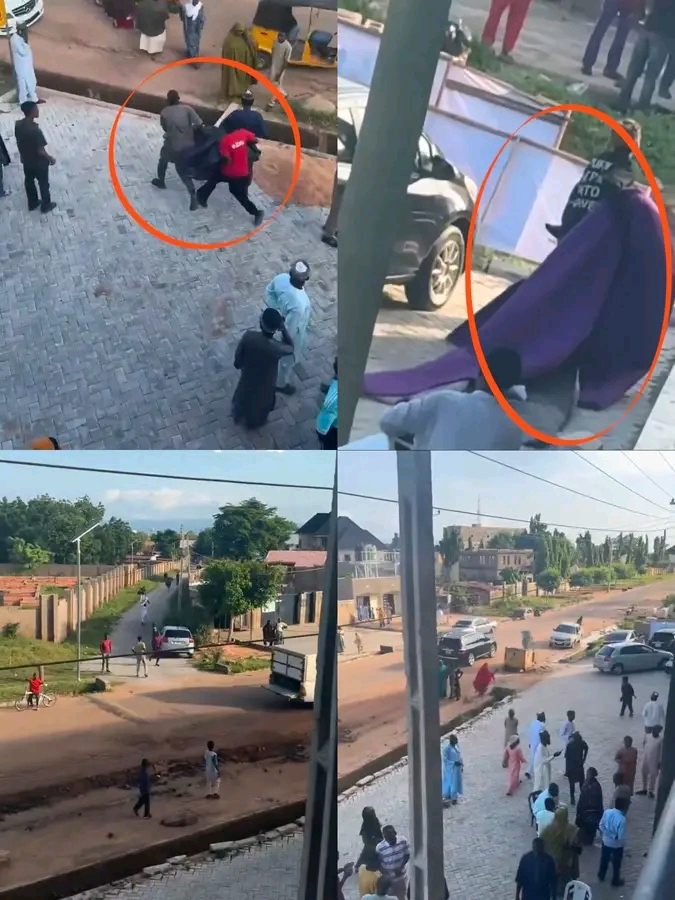

A woman has been filmed standing up to a group of men who stormed her construction site in Valley Estate, Ikeja, Lagos State, claiming to be Omonile (a Yoruba term meaning “children of the soil,” commonly used for people who claim traditional ownership of land, but also widely used to describe land grabbers who extort property owners).
In the video, the woman is heard confronting the men after they broke down her fence. She insists that her family’s ownership of the land is not in doubt, since it comes with a Certificate of Occupancy, or C of O (the official government document that proves a person has the legal right to occupy and use a piece of land in Nigeria). Despite this, the men reportedly pressed ahead with their claims and damaged the property.
The incident is one of many that have played out on construction sites across Lagos in recent years, as families and developers battle groups who show up mid-project to demand money, sometimes by force.
A problem that has followed Lagos for decades
Land grabbing in Lagos is not new. Groups calling themselves Omonile have for years been accused of showing up at building sites to demand payment at almost every stage of construction, from the laying of the foundation to roofing, even when the landowner already has full legal documents. One man who lost his land to these groups described Omonile as land grabbers who can sell the same plot to more than six different buyers while still holding on to it, and who show up at every stage of building work to demand money.
Similar cases have made headlines in the past. In 2023, a land dispute in Lagos turned violent when a group led by a man identified as a land grabber allegedly invaded a site with armed escorts. Workers on the ground said they were beaten and stripped, then taken into the bush, and were only saved by passing farmers.
More recently, in February 2026, the family of a late Nigerian statesman said suspected land grabbers, allegedly working with certain government officials, demolished a fence on their property in Ikorodu, Lagos, and carted away construction materials, even though the family holds registered ownership documents older than the C of O system itself.
Why this keeps happening, and who it hurts
Several factors keep this problem alive in Lagos. Land in the state is extremely valuable, and some groups exploit gaps in enforcement to extort property owners, betting that developers would rather pay than deal with lengthy court cases. In some cases, officials meant to protect landowners have themselves been accused of taking sides, which makes victims feel they have nowhere safe to turn.
For individuals, the effects are heavy. People lose money meant for building their homes, projects are delayed or abandoned, and workers and family members can be hurt when confrontations turn violent.
The effects go beyond individual families, though. Land grabbing frightens off real estate investment, both from Nigerians in the diaspora and from foreign investors who might otherwise put money into housing and infrastructure in Lagos. Analysts have long pointed to Omonile activity as one of the things that discourages investors and makes it harder to do business in the state. The state government itself has acknowledged that the menace of forceful land grabbing and illegal levies has hindered the ease of doing business in Lagos. Fewer housing projects getting completed also worsens Nigeria’s housing shortage, a problem that affects the whole country, not just Lagos.
What is being done, and what more could help
Lagos State has tried to tackle the problem before. In 2016, the state government signed the Lagos State Properties Protection Law, aimed at stopping forceful entry, illegal occupation and violent conduct linked to land. A Special Task Force on Land Grabbers was also set up to investigate petitions and prosecute offenders.
Even so, cases like the one in Valley Estate suggest enforcement still has gaps. Legal experts and residents have called for faster response times when landowners report threats, harsher punishment for repeat offenders, and clearer public information so people know exactly which office to contact when they are targeted. Some also argue that greater transparency in land administration, including making it easier to verify ownership records, would reduce the room these groups have to operate.
The Bigger Picture
What stands out about the Valley Estate case is that the woman had done everything right. She held a C of O, the very document Nigerians are told will protect them, and men still showed up to break her fence and press their claims anyway. That should worry anyone who has ever been told that paperwork alone will keep their property safe in Lagos.
The truth is that documents mean little without enforcement that people can count on. Until Lagos State can guarantee that landowners with valid titles will not be extorted or attacked on their own property, families will keep filming these confrontations and hoping the footage, rather than the law, is what finally protects them.
Published by Ejoh Caleb