
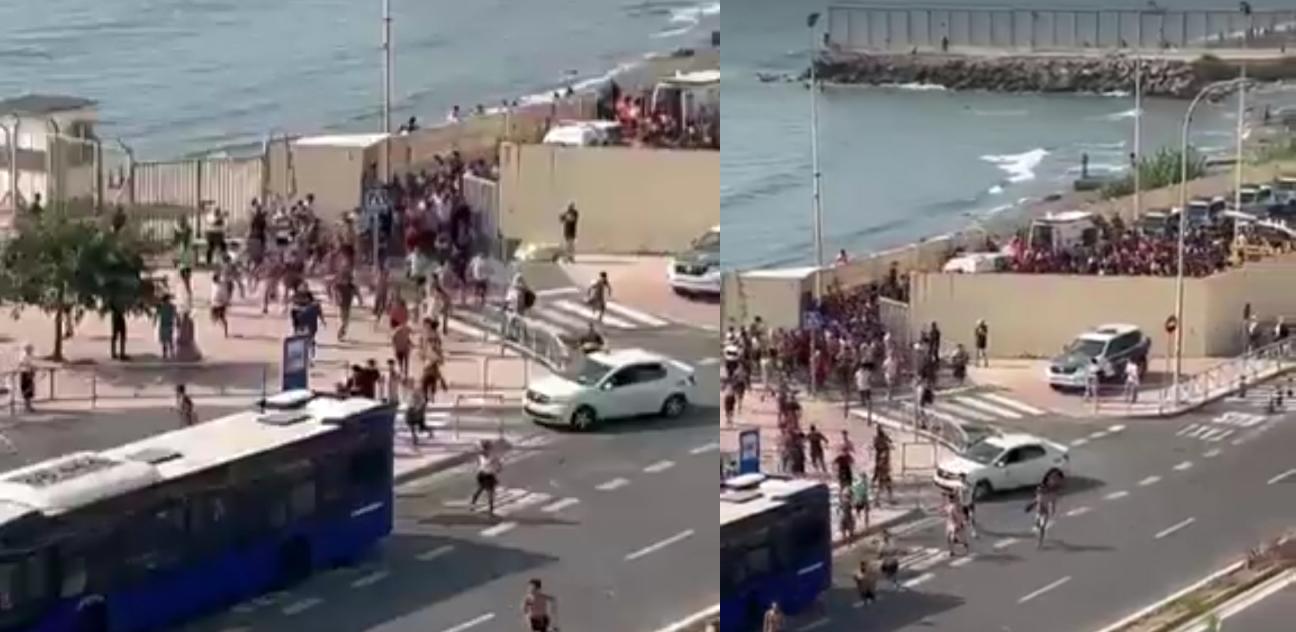
Ceuta, a small Spanish city on the north coast of Africa, has declared a humanitarian and security emergency after a sharp rise in migrants crossing in from neighbouring Morocco. Ceuta’s regional president, Juan Jesús Vivas, called it a “total humanitarian and social emergency” after hundreds of people swam across the border in recent days.
About 1,500 people have reached Ceuta in the past week alone, with roughly 300 arriving every single day. Videos from Tarajal beach show crowds, mostly young men but also families with women and children, walking around breakwaters and running along the beach and roads, with some shouting “Viva España!” to photographers on the scene.
Ceuta’s reception centre for migrants, built to hold 512 people, is now sheltering more than 600. Centres meant for unaccompanied migrant children are said to be operating at 2,400% of their designed capacity, forcing hundreds of people to sleep outdoors.
What is Ceuta asking Madrid to do?
Vivas has formally asked the national government in Madrid to declare a national emergency and deploy the Spanish army to the border, saying more police and soldiers are needed “to guarantee the inviolability of the frontier and citizen safety.” The request has cross-party backing in Ceuta: representatives from the PP, PSOE, Vox, and two other local parties jointly called for the national emergency declaration, the closure of the Tarajal border crossing, and army deployment, after an emergency meeting on the surge.
Spanish Prime Minister Pedro Sánchez responded on social media, saying his government is “fully focused on giving an immediate response to the situation in Ceuta,” and is “mobilising all necessary resources” while working with Moroccan and international authorities to restore normality as soon as possible. As of the time of writing, Sánchez’s government has not confirmed whether it will send in the army, and Vivas’s request was described as still pending a response from Madrid.
The crisis has also sharpened political attacks on Sánchez. Opposition leaders, including PP leader Alberto Núñez Feijóo and Vox leader Santiago Abascal, have publicly urged the government to mobilise the army immediately, with Vox going further and demanding the resignations of Sánchez and his interior minister over the handling of the crisis.
Ceuta has faced this before
This is not the first time Ceuta has been overwhelmed. In May 2021, around 8,000 to 10,000 migrants crossed into the enclave in just two days, after Moroccan border police appeared to briefly loosen controls amid a diplomatic dispute with Spain. That crisis included about 1,500 to 2,000 unaccompanied minors. Sánchez, at the time, called it a “serious crisis for Spain and Europe,” cancelled an international trip, and deployed Spanish troops and hundreds of extra police to the border within a day. Spain also expelled thousands of migrants back to Morocco under an existing bilateral return agreement. Vivas has warned that without decisive action now, Ceuta could return to that same scale of crisis within a month.
Why is this happening now, and who does it affect?
Several factors are feeding the current surge. Spain’s Supreme Court ruled on July 8 that migrants intercepted at sea while trying to reach Ceuta or Melilla cannot be automatically returned to Morocco the way those caught at the land border fence can, since open water doesn’t offer the same legal grounds for immediate pushback. Police associations had warned that ruling would encourage more people to attempt the crossing. The surge also comes as Spain processes nearly 1.3 million applications under a mass migrant regularisation programme, a policy both the PP and Vox oppose and blame for encouraging more arrivals.
For Ceuta’s roughly 85,000 residents, the effect is an overstretched city — overcrowded shelters, people sleeping on the streets, and strained police and social services. For migrants themselves, the crossing is dangerous; some are swimming around sea breakwaters to avoid the border fence entirely, and past surges have led to deaths.
Beyond Ceuta, this touches all of Spain and the European Union. Ceuta and Melilla are the EU’s only land borders with Africa, which means whatever happens at this border shapes migration policy debates across the whole bloc. The crisis has also become a flashpoint in Spanish domestic politics, feeding into a wider fight over Sánchez’s migration policy ahead of future elections.
Is there a path forward?
Spain has tools it has used before: deploying troops and extra police to secure the border, as it did in 2021; working with Morocco to tighten controls on its side of the fence; and using bilateral return agreements to send migrants back where legally possible. Ceuta’s local politicians have also proposed extending the sea breakwaters at Tarajal and Benzú, which they say are currently being used as an easy entry route around the fence.
At the same time, some voices are pushing back against a purely security-focused response. The left-wing Sumar movement, part of Spain’s governing coalition, has called instead for a coordinated response that strengthens reception capacity and protects children, warning against the kind of rapid “hot returns” that critics say violate legal safeguards.
The Bigger Picture
What stands out to me here is how familiar this crisis feels. Ceuta has lived through this exact scenario before, in 2021, and the warning signs of a repeat were reportedly flagged well before this week’s numbers grew. That raises a fair question for Madrid: why does the response always seem to arrive after a city is already overwhelmed, rather than before? At the same time, I think it’s worth resisting the urge some political voices are pushing — to frame every migrant arrival as an “invasion” rather than what much of it actually is, a mix of desperate people and a border management failure between two governments. Spain, and the EU behind it, needs a plan that treats border security and human dignity as equally serious, not as a choice between the two.
Published by Ejoh Caleb