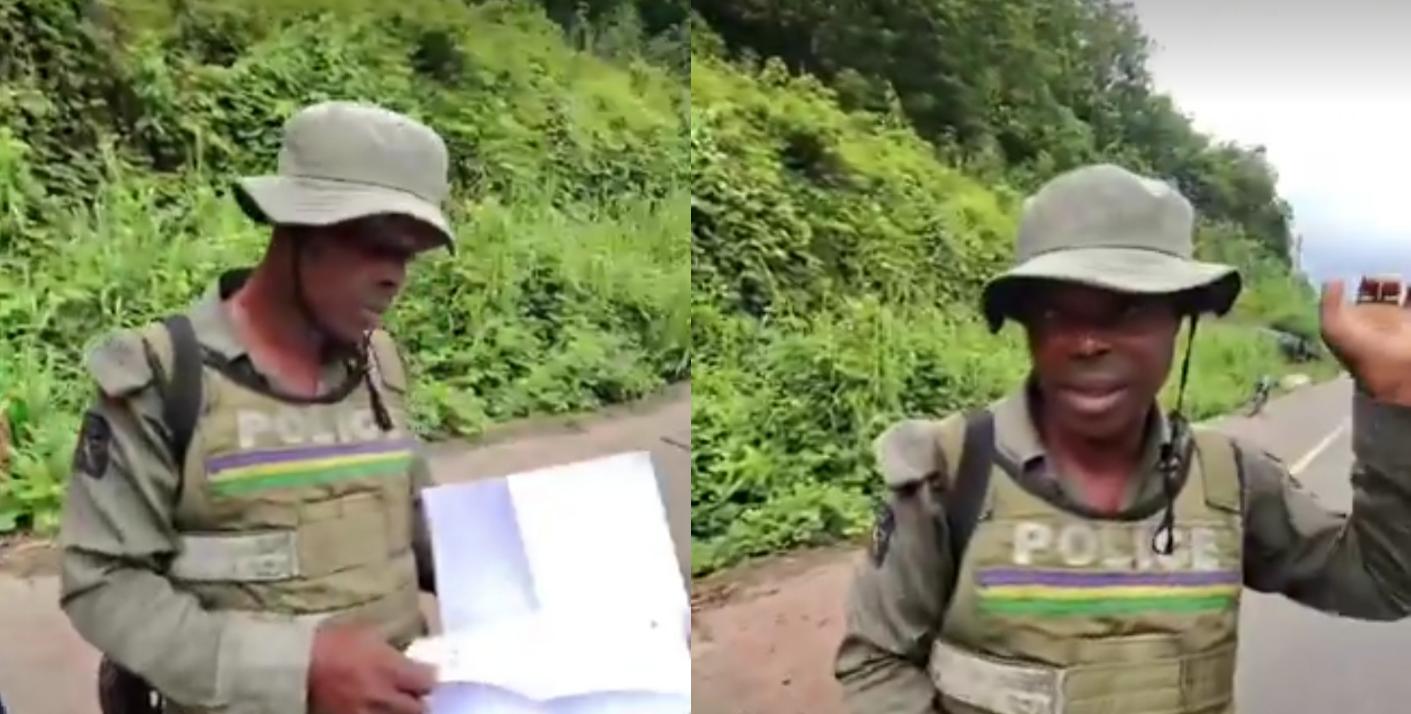
A viral video showing a Nigerian police officer seizing a motorist’s driver’s licence after the man refused to pay a bribe has led to the arrest of four officers in Ondo State. The incident happened during a stop-and-search operation on the Lagos-Ibadan Expressway.
In the video, one of the officers checked the motorist’s vehicle documents, confirmed they were valid, and then asked him to go and “do something better” — widely understood in Nigeria as a request for a bribe. When the driver told the officer he had nothing to give him, the officer seized his driver’s licence and ordered him to park his vehicle for further checks.
The video also captured one of the officers making an ethnic remark after the motorist refused to pay, telling him, in part, that he would have let him go without trouble “if you were Igbo or another person.”
Social media activist Martins Vincent Otse, popularly known as VDM, shared the video and called on the Inspector-General of Police, Kayode Egbetokun, to investigate and dismiss the officer involved.
The Ondo State Police Command responded quickly. Police spokesperson Abayomi Jimoh named the four officers involved as Elomore Sodayo, Adefila Adewale, Olorunfemi Opeyemi, and Odusola Peter, all inspectors, and confirmed they had been taken into custody while a full investigation is carried out. He promised the process would be fair, transparent, and accountable.
A Familiar Story on Nigeria’s Highways
Checkpoint extortion has been a persistent complaint on Nigerian roads for years, and this is far from an isolated case.
Just weeks earlier, in May 2026, a Nigeria Customs officer was filmed allegedly demanding ₦200,000 from a motorist on the Lagos-Benin Expressway, claiming it was for unpaid duty from 2018. The motorist secretly recorded the exchange, and the Customs Service later paraded the officer and began disciplinary action.
In 2025, a viral video showed a police officer at a checkpoint on the Benin Bypass in Edo State demanding five litres of fuel or ₦5,000 from motorists whose only “offence” was not having proof of a vehicle registration scheme that police authorities had themselves suspended the year before.
Similar cases have played out on the Lasu-Ojo Expressway in Lagos, where an officer was once filmed collecting a bribe and seizing car keys from commercial drivers who could not pay immediately, and along the Berger-Isheri link road to the Lagos-Ibadan Expressway, where officers accused motorists of “beating the traffic light” to extract cash.
A 2010 Human Rights Watch investigation found that police extortion in Nigeria was so deeply built into the system that officers were expected to pay a share of bribe money up the chain of command, a practice researchers called “paying returns,” with officers sometimes even harming or killing people who could not pay tiny amounts.
Why Checkpoint Extortion Refuses to Go Away
Police corruption researchers and officers themselves point to a mix of causes.
Officers are often sent out on patrol with little or no official budget for basic needs like fuel, forcing some to look for money from motorists just to carry out their duties, according to testimony gathered by Human Rights Watch.
Weak, slow accountability is another factor. Even when officers are caught on camera, cases can take a long time to conclude, and many extortion attempts are never filmed or reported at all.
The sheer number of checkpoints on Nigerian highways, despite repeated official bans on illegal ones, also creates constant opportunities for individual officers to demand money from motorists with little oversight.
How This Affects Nigeria Beyond One Angry Motorist
For the individual driver involved, being stopped, questioned, and having a licence withheld despite valid documents wastes time, causes stress, and can leave a motorist stranded on a busy highway.
For the police force, each viral video chips away further at public trust, making ordinary Nigerians more likely to see officers as a threat to avoid rather than protection to rely on.
For Nigeria as a country, stories like this shape how the country is seen by outsiders, including Nigerians living abroad who visit home and by potential investors who read about road safety and rule of law before deciding where to put their money. Persistent, well-documented corruption at checkpoints also undermines broader government efforts to reform the police and improve Nigeria’s global image.
What Could Help End Checkpoint Extortion
Police authorities could equip more officers with body cameras, so interactions with motorists are automatically recorded rather than relying on the motorist to film.
The Nigeria Police Force could reduce the number of checkpoints on major highways and clearly publicise which ones are authorised, making it easier for the public to report illegal ones.
Officers should be given proper operational budgets for fuel and basic needs, reducing one incentive for extortion identified by researchers.
Disciplinary cases arising from viral videos, like this one, should be concluded and made public quickly, so consequences are clear and consistent.
The public could be given an easy, well-publicised way to report extortion in real time, separate from having to go viral on social media first to get a response.
Our Take
What stands out to me in this case is how fast the Ondo Police Command moved once the video spread — arresting four officers in less than a day. That speed is welcome, but it also raises a question: how many similar incidents happen every day on Nigerian roads without a camera rolling, and simply go nowhere? A justice system that only works when a video goes viral is not really a justice system at all. If the Force wants to convince Nigerians that this arrest is not just a public relations move, the investigation needs to be concluded and the outcome shared just as widely as the original video was.
Published by Ejoh Caleb