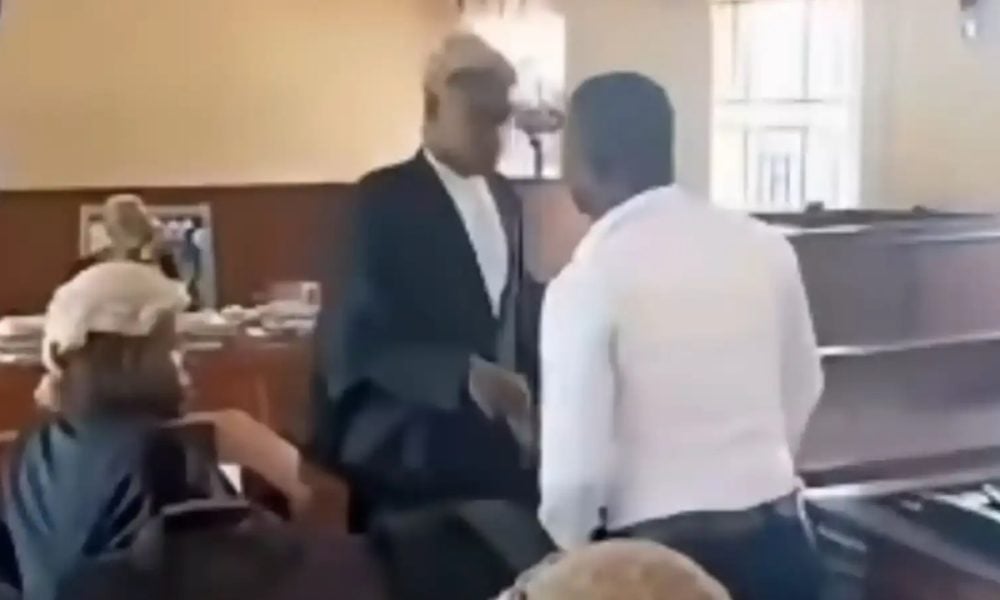
A Lagos courtroom erupted into chaos after a judge accused a man dressed in a lawyer’s wig and gown of impersonating a legal practitioner and ordered his immediate arrest. “Remove that your wig. I’m ordering for his arrest right away. Police, arrest him!” the judge was heard saying in a video circulating online.
The man, who had come to court to represent a client, reportedly tried to flee the courtroom the moment the arrest order was given, before officers moved to apprehend him. Details about the man’s identity, the client he was representing, and the specific case before the court were not immediately clear from the footage.
A Recurring Problem in Nigeria’s Courts
This is not an isolated case. Just weeks earlier, a Lagos State High Court in Ikeja convicted a 55-year-old man, John Nwawuto Anoruo, for impersonating a legal practitioner and using a forged Nigerian Bar Association (NBA) seal — an official stamp that shows a lawyer is properly registered to practice. Investigators found that Anoruo, who ran a legal consultancy in Ikorodu, had collected ₦7.5 million from a client for a legal brief but secretly paid a real lawyer only ₦1.5 million to handle the actual case. He was fined ₦270,000 and had his forged seal and legal attire seized.
In a similar earlier case in Ogun State, a man named Azeez Agboola was arrested inside a courtroom in Agbara after a magistrate grew suspicious of the way he carried himself while appearing as counsel. He later admitted he had studied law but had never been formally called to the Nigerian Bar.
Why Fake Lawyers Keep Slipping Into Courtrooms, and Who Gets Hurt
People pose as lawyers mainly for money. Legal representation can be expensive, so some clients unknowingly hire cheaper, unqualified people who claim to be lawyers, while the impostors pocket fees for work they are not licensed to do. In the Anoruo case, this meant a client who paid ₦7.5 million for legal help never actually had a qualified lawyer directly handling their case. It also happens because Nigeria’s legal system relies heavily on the honour system — lawyers wear a recognisable wig and gown, and courts don’t always verify credentials in real time unless something raises suspicion.
For the individual client, the effect can be devastating: a case handled by an unqualified person can be poorly argued, delayed, or lost entirely, sometimes with serious personal or financial consequences. For the legal profession, every viral case like this chips away at public trust in lawyers generally, making it harder for genuine legal practitioners to be taken at their word. At the national level, repeated cases of legal impersonation reflect weaknesses in Nigeria’s regulatory system for verifying who is actually licensed to practice law, and they add to a broader picture of impersonation and fraud that discourages ordinary Nigerians from trusting formal institutions, including the courts meant to protect them.
Closing the Gaps That Let Impostors Through
Nigerian law is already clear that only people called to the Nigerian Bar and listed on the official Roll of Legal Practitioners maintained by the Supreme Court can represent clients in court or use an NBA seal. The Nigerian Bar Association has urged the public to verify a lawyer’s status before hiring them, rather than relying on appearances like a wig, gown, or claimed qualifications.
Courts themselves could reduce these incidents by routinely checking practitioners against the official roll before proceedings begin, rather than relying on a judge noticing something suspicious mid-hearing. Faster and more visible prosecutions, alongside penalties that reflect the seriousness of the harm caused to clients, could also discourage others from attempting the same scheme. For members of the public, checking a lawyer’s enrollment status with the NBA before paying any fees remains one of the simplest ways to avoid falling victim to impersonation.
A Warning Sign We Shouldn’t Need a Viral Video to Notice
We find it unsettling that it so often takes an alert judge, and not the system itself, to catch someone impersonating a lawyer in open court. If Anoruo’s case is anything to go by, these impostors can operate for months, even years, collecting real money from real clients before anyone questions their credentials. We believe the answer isn’t just punishing the people caught on camera, but building simple, routine checks into the legal process so that a person’s right to stand in court and represent someone else isn’t left to chance or a judge’s instinct. Until verification becomes automatic rather than accidental, we suspect this won’t be the last “remove that your wig” moment Nigerians see online.
Published by Ejoh Caleb