

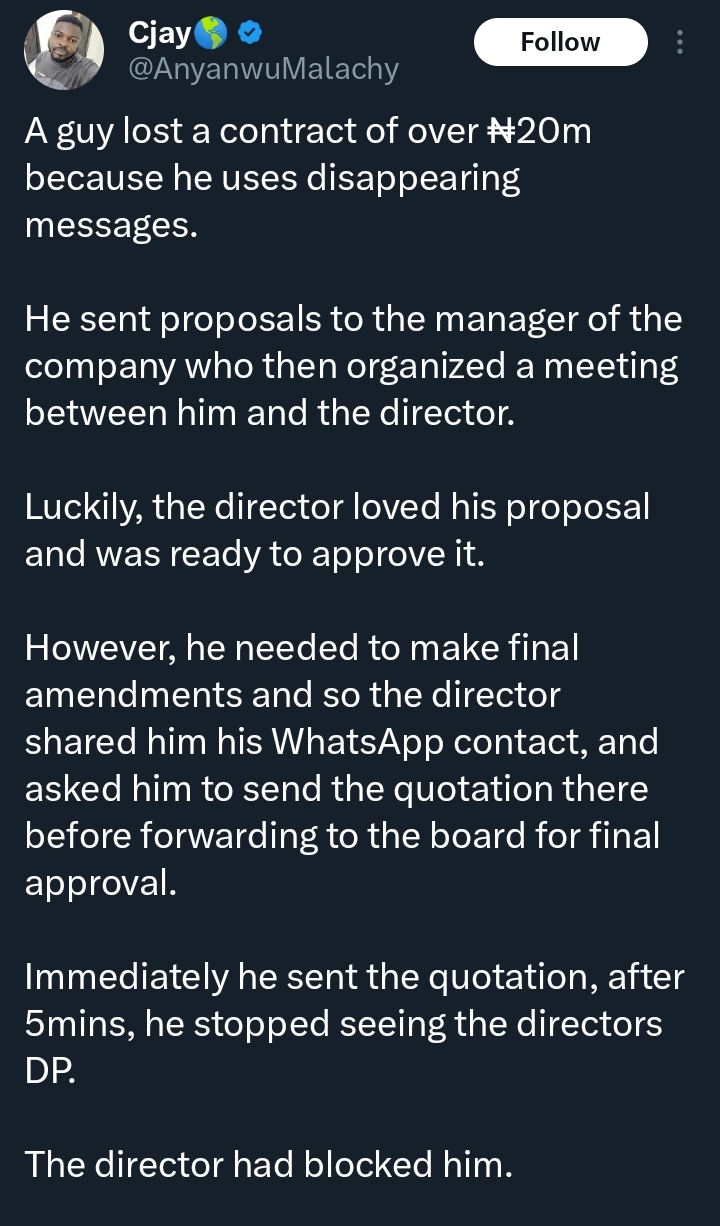
A social media user has sparked discussion online after sharing a story about a businessman who allegedly lost a contract worth over ₦20 million because of a setting on his WhatsApp account.
According to the account posted on X, the businessman had submitted a proposal to a company and successfully impressed a manager, who subsequently arranged a meeting with the firm’s director.
The proposal reportedly received favourable feedback during the meeting, with the director expressing interest in approving the project.
Before giving final approval, however, the director allegedly requested some adjustments to the proposal and provided his WhatsApp contact so that a revised quotation could be submitted directly to him. The businessman reportedly complied and sent the updated document.
The situation is said to have changed shortly afterwards. According to the story, the businessman noticed that the director’s WhatsApp display picture disappeared just minutes after the revised quotation was delivered.
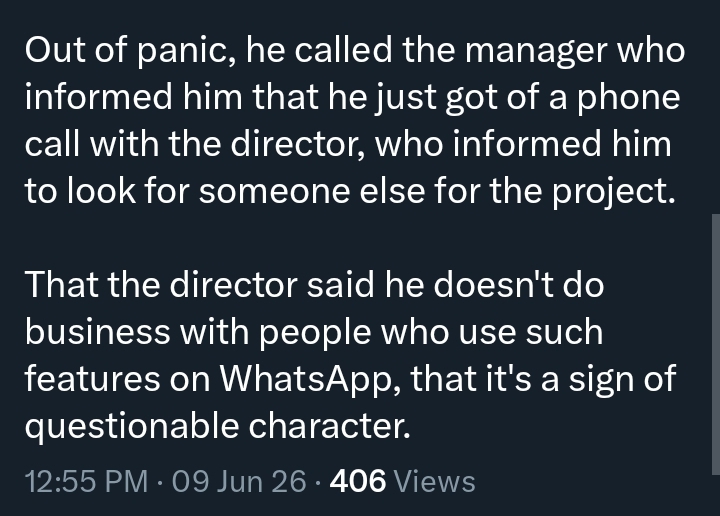
Concerned by the development, he reportedly contacted the manager handling the process to seek clarification.
The manager allegedly informed him that the director had decided to discontinue discussions regarding the contract and instructed the company to look for another contractor instead.
According to the X user, the decision was linked to the businessman’s use of WhatsApp’s disappearing messages feature. The director reportedly viewed the setting as a red flag and interpreted it as a sign of questionable character, leading him to lose confidence in proceeding with the business relationship.
The claim has since generated debate online, with some users arguing that disappearing messages are a legitimate privacy feature, while others believe certain communication settings can influence perceptions of trust and professionalism in business dealings.
Reactions
“Imagine losing ₦20 million because of a WhatsApp setting. First impressions matter in business.”
“Disappearing messages don’t mean someone is dishonest. Many people use it for privacy.”
“For official business, it’s better to keep communication settings as transparent as possible.”
“If this story is true, the director probably felt important records could disappear when needed.”
“This shows how small details can affect major business opportunities.”
Published by Ejoh Caleb