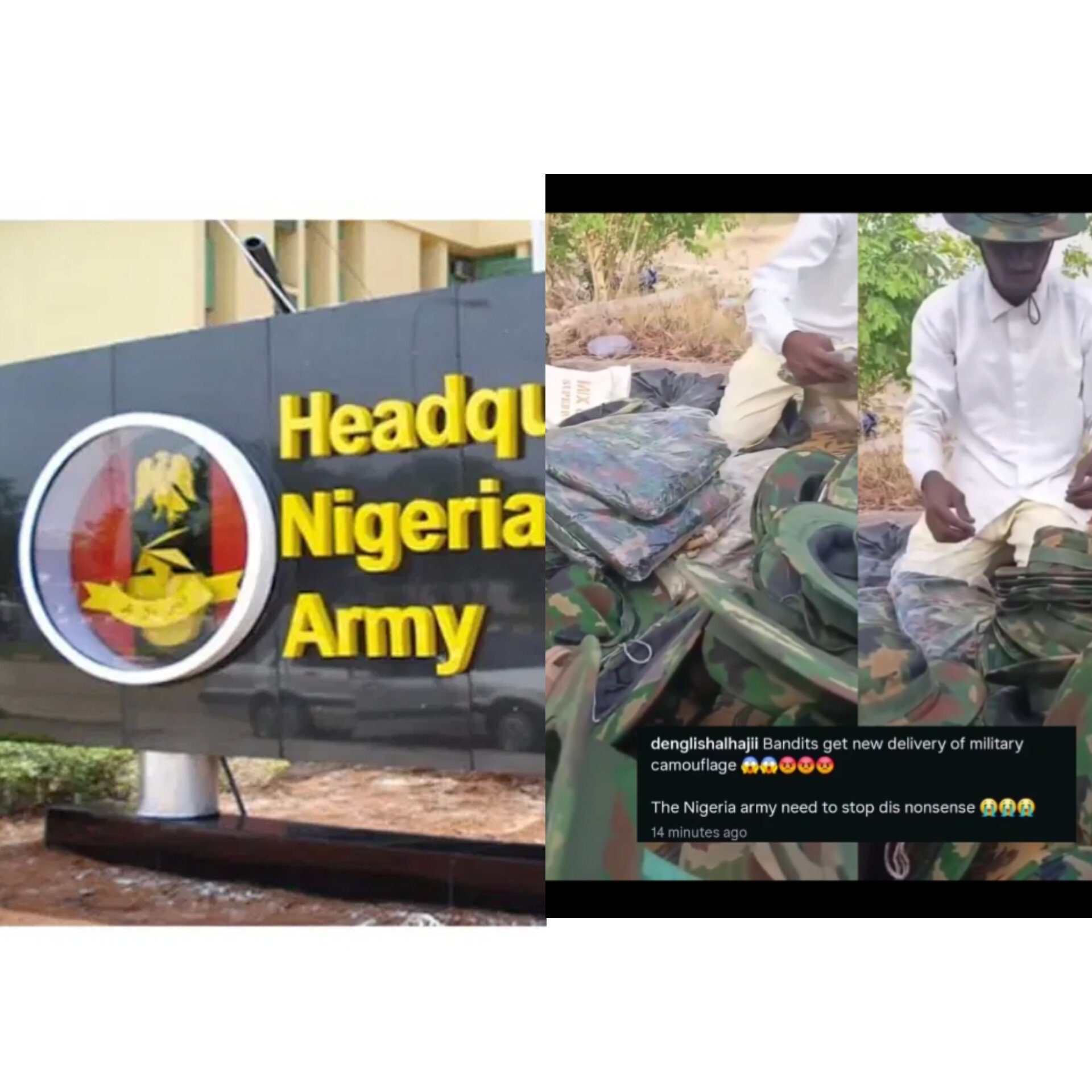
The Defence Headquarters (DHQ) has denied supplying military camouflage uniforms seen in a viral video of suspected bandits. The video shows large quantities of woodland and desert camouflage uniforms spread on the ground, with more packed in sacks.
Asked whether the uniforms came from the military, the Director of Defence Media Operations, Maj. Gen. Michael Onoja, said, “That is not possible.” He also dismissed suggestions that bandits stole them from military supply vehicles, saying no such attack had been reported. “It is not from the Nigerian military,” he added.
What the DHQ Said and What It Did Not Say (A Denial Is a Statement Rejecting a Claim)
The DHQ’s statement rules out two explanations: that the military supplied the clothing, and that bandits looted it from supply vehicles. What it does not do is explain where the uniforms did come from. Reports note that the military did not say where it believes they originated, and that Onoja did not say whether the military would investigate.
That leaves a gap. A denial answers the question of whether the military is responsible. It does not answer the question that worries the public, which is how a group can hold so many uniforms. We have no information on the video’s date, its location or the identity of the people in it, and no official has said whether the footage has been checked.
Warnings That Pre-Date the Video: Rules, Seizures and Fake Soldiers (Impersonation Means Pretending to Be a Member of the Armed Forces)
The problem is not new. In February 2024, the Federal Government restated its limits on the use of military camouflage by civilians, to stop criminals from misusing security uniforms and equipment. Minister of State for Defence Bello Matawalle said the restrictions were needed so that security agencies could tell real personnel from impostors.
On June 23, 2026, the Lagos State Police Command announced it had intercepted 47 sacks of military camouflage uniforms and 80 cartons of suspected illicit substances reportedly bound for the South-East. Authorities have not established any link between that seizure and the uniforms in this video.
Recent arrests show the same risk. On October 30, Bauchi police arrested a 26-year-old man who allegedly posed as an army officer, assaulted a prospective employer and stole his car. On November 3, Ogun police arrested a man known as “General Don” for allegedly impersonating military personnel. Those suspects have not been linked to the video either.
How Criminals Could Obtain Uniforms: Markets, Tailors and Leaks (Illicit Supply Means Goods Obtained or Sold Outside the Law)
Reports do not say how the uniforms in the video were obtained, and the DHQ has not given an answer. We can describe general possibilities without claiming any applies here. Camouflage can be sewn by tailors, sold in open markets or smuggled in bulk, as the Lagos seizure shows. Genuine uniforms can also leave official hands through theft or sale, though the DHQ says that did not happen in this case.
The distinction matters. A stock of copied uniforms points to a market that needs better control. A stock of genuine military uniforms would point to leaks inside the system. The public cannot tell which it is without an investigation, and the DHQ has not said whether one is under way.
Why Uniforms Matter in Armed Crime: Cover, Confusion and Fear (Cover Means Something That Hides Real Intent)
A uniform can help armed groups in several ways. It can let attackers approach a village or checkpoint without alarm, or make victims more willing to follow orders. It can also blur the line between soldiers and criminals, so villagers may not know whether to flee or to trust a patrol.
In a country where many rural communities already live with fear of bandits, that confusion can cost lives. Soldiers may also be wrongly blamed for abuses done by impostors, which damages their standing. And when people cannot tell the difference, they may be less likely to cooperate with real troops.
What This Costs the Nation: Trust in the Military, Safety in the Villages and Public Confidence
If the public believes bandits can easily get military uniforms, trust in the security services falls. Even a denial from the DHQ may not settle doubts if no investigation follows, because people will ask who supplied the clothing and whether anyone is accountable.
The wider cost is to national security. A criminal who looks like a soldier can move more freely, and security forces must spend more time checking identity. The result can be slower response, more risk to civilians and more pressure on already stretched forces.
Closing the Gap: Tracing Suppliers, Tighter Rules and Public Verification
The first step is tracing. The military, police and customs can work together to find out where the uniforms in the video came from, and say publicly what they find. If they are copies, authorities can follow the trail to tailors, importers and market traders. The government can enforce the existing restrictions on who may sell and buy camouflage cloth and uniforms.
The public can help by reporting suspicious bulk sales, and by learning how to verify a soldier’s identity through official channels. The DHQ can also publish clear guidance on how civilians can check whether a person in uniform is genuine.
A Denial Is a Start, Not an Answer: Our Reading of the Camouflage Question
We take the DHQ’s denial seriously, and we do not claim the military supplied these uniforms. The senior officer was clear, and no attack on a supply vehicle has been reported.
But a denial alone cannot calm the public. People want to know where the clothing came from, who sold it and whether anyone will be held to account. They also want to know how a group can hold such a stock.
We urge the DHQ, the police and the customs service to investigate and to publish what they find. We urge civil society and the media to keep asking. In a country fighting armed groups, the uniform must mean something. If it does not, ordinary people will pay the price.
Published by Ejoh Caleb