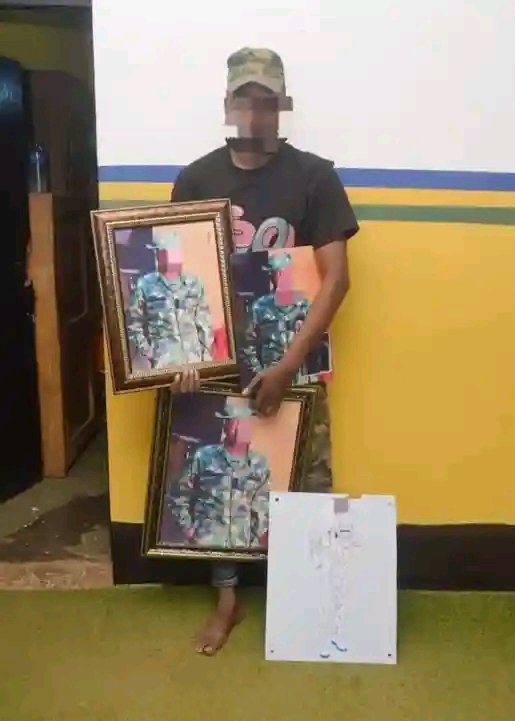
The Ogun State Police Command has arrested Akinola Damilare, popularly known as “General Don”, for allegedly impersonating military personnel in Abeokuta. Police said officers of the Special Weapons and Tactics (SWAT) Unit arrested him at about 2:00 a.m. on Tuesday, November 3, 2026, at Kajola, Elega, Abeokuta.
Police said the arrest followed credible intelligence from a community leader and discreet surveillance by SWAT operatives. They listed the items recovered: a military face cap, three-quarter military trousers and four photographs showing him in military uniform.
What Police Say and What They Have Not Said (A Suspect Is a Person Accused but Not Yet Found Guilty)
The police spokesperson, DSP Oluseyi Babaseyi, said investigators are working to establish the circumstances of the alleged impersonation and to find out whether others are connected. Commissioner of Police Bode Ojajuni said the command is determined to tackle impersonation and other crimes, and urged residents to report suspicious conduct promptly.
Important facts are still missing. Platform Times noted that police did not say whether the suspect had used the alleged military identity to intimidate residents, extort money or commit other offences. We also have no charge, no court date and no statement from the suspect. He is presumed innocent until a court decides otherwise, and the claim that he is a fake soldier remains an allegation.
A Growing List of Cases: Earlier Arrests of People Posing as Soldiers (Impersonation Means Pretending to Be Someone You Are Not)
Similar arrests have been reported in recent weeks. On October 30, 2026, Bauchi police arrested a 26-year-old man, John Umar Shehu, for allegedly impersonating a Nigerian Army officer, assaulting a prospective employer and stealing his vehicle. Police said they recovered several army uniforms and that he claimed to be a private with a service number, attached to a battalion in Borno State.
In December 2024, the Abuja police arrested a man, Emmanuel Linus, who was allegedly wearing a full army uniform and carried a fake military ID card. Police said he belonged to a group that bought goods with fake bank alerts. In 2018, the Nigerian Army’s 81 Division in Lagos arrested 13 people accused of impersonation in Lagos and Ogun states. The army said some were deserters or dismissed soldiers who helped others to get fake IDs and uniform items.
These cases differ from the Ogun one, because the others involved reported crimes such as theft or fraud. No such crime has been reported against “General Don”. The common thread is the use of a uniform to win trust or fear.
Why a Uniform Works: Respect, Fear and Few Ways to Check (Authority Means the Power to Be Obeyed)
In many communities, a uniform signals power. People may step aside, answer questions or hand over money to a person they believe to be a soldier. Few people know how to check a service number or an ID card, and many would fear asking.
Photographs add to the effect. A picture in uniform shared on social media can build a reputation, and a nickname like “General” can add weight. We do not know whether that happened here. But it shows why impersonation can fool a neighbourhood even when the person has no real authority.
The Harm a False Soldier Can Do: Danger to Citizens, to the Army and to the Country
For individuals, the harm can be direct. A false soldier may threaten, rob or extort people who think they cannot refuse. Victims may also be afraid to report a person they believe has powerful friends.
The wider cost reaches the country. Every impostor weakens trust in genuine soldiers, who risk their lives, and a public that cannot tell the difference may fear or resist real troops. Impersonation can also help criminals, including kidnappers, move around or approach victims unchallenged. In a country already facing insecurity, anything that blurs the line between real and fake security forces adds to the danger.
Credit for Quiet Policing: A Community Tip, Watchful Officers and Open Questions (Intelligence-Led Policing Means Acting on Gathered Information Rather Than Chance)
The police deserve credit for the way this arrest was made. A community leader raised the alert, and SWAT officers watched the suspect before acting. That model, which uses local information and careful follow-up, can protect both the public and the officers.
There are also questions to answer. What exactly did the suspect do while in uniform, if anything? Did he gain money or favours from anyone? Did he have help? Without answers, the public cannot judge the scale of the problem. The police have said investigations are continuing, and we hope the findings will be shared.
Spotting and Stopping Impostors: Simple Checks, Clear Reporting and Firm Prosecution
Communities can take simple steps. Residents who meet someone claiming to be a soldier can ask where he is posted, and report concerns to the police or the nearest army unit instead of confronting him. Community leaders can keep contact numbers for local army and police commands.
The army and police can publish easy ways to verify identity, including hotlines. Shops that sell military-style clothing can be encouraged to ask questions about large orders, and the authorities can track who supplies uniforms. Courts can also treat impersonation seriously, so that others see a real cost.
A Uniform Earned, Not Borrowed: Our Reading of an Arrest in Abeokuta
We commend the community leader who spoke up, and the officers who acted on the tip. Quiet cooperation between citizens and police is how many crimes are prevented.
We also hold back. The man in custody is a suspect and has not been charged. We do not know if he harmed anyone, and we will not suggest that he did. The facts must come from the investigation.
We urge the Ogun police to share their findings, including any accomplices and any victims. We urge Nigerians to value the real uniform by asking questions when they doubt it. A uniform means a promise of service, and it should never be a costume for deceit.
Published by Ejoh Caleb