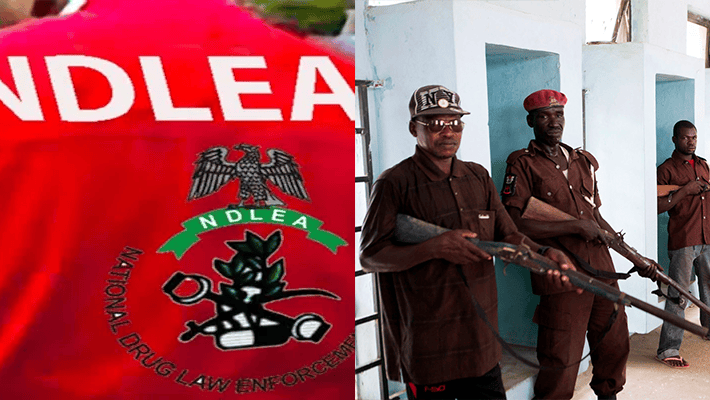
The National Drug Law Enforcement Agency (NDLEA) has issued a public alert warning travellers after officers intercepted a keg of palm oil used to hide illicit drugs at an airport. The agency’s media director, Femi Babafemi, posted the warning on X under the title “Public Alert,” with a video showing officers removing substances wrapped in polythene from the keg. He said the keg was given to a woman travelling to Saudi Arabia to deliver to another person there, and that she was intercepted before she could leave. He warned that she would have faced severe consequences if the drugs had been found in Saudi Arabia, and urged Nigerians to share the alert.
A longer NDLEA statement gives more detail. It says the interception took place on Friday, October 16, 2026, at Mallam Aminu Kano International Airport during outward clearance of an Ethiopian Airlines flight to Jeddah via Addis Ababa. A gallon of palm oil in the passenger’s luggage allegedly contained 511.75 grams of cannabis, known as skunk. The passenger, named as Fatimah Ahmad, told investigators her cousin, Abubakar Yahaya, had given her the container, and he was arrested in the airport car park. These are NDLEA’s claims. Whether she knew what was in the keg is for the investigation and the courts to decide, and neither person has been convicted.
Saudi Arabia Treats Drug Cases Severely, and Nigerians Have Paid the Price: Past Cases of Couriers Caught Abroad (Earlier Cases Involving Saudi-Bound Travellers)
Saudi Arabia punishes drug trafficking with death, and Nigerian travellers have been among those executed. In April 2019, Saudi authorities executed a Nigerian woman, Kudirat Afolabi, for drug trafficking. The Federal Government’s diaspora aide at the time, Abike Dabiri-Erewa, said she was the eighth Nigerian executed for drug offences in three years, and that 20 others were on death row. She also said some of them might not have committed the crime. She said there was evidence of airlines working with drug syndicates to put banned substances into the luggage of innocent Nigerians, especially pilgrims. That was her claim, and we have not seen court findings on it.
A Daily Trust writer made a similar point about Kano. He said callous traffickers at the same airport were taking advantage of unsuspecting Saudi-bound Umrah and Hajj travellers by planting drugs in their luggage, hoping their innocent appearance would attract less scrutiny. He added that a few victims had been saved with the help of the Nigerian Consulate-General in Jeddah. More recently, ThisDay reported that 10 Nigerians were among 89 foreign nationals executed in Saudi Arabia in 2024, mostly for drug offences.
Concealment in ordinary objects is a known method. In April 2025, NDLEA said it found 500 grams of cocaine in 20 parcels hidden inside pages of religious books at a Lagos courier company, destined for Saudi Arabia. That case involved cargo and not a passenger, but it shows how traffickers disguise drugs as harmless items.
Why Familiar Items and Familiar Faces Make the Perfect Cover: Causes Behind Such Schemes (Concealment and Trust)
The first cause is disguise. Traffickers pack drugs into items that look normal and are commonly carried, such as food, books or household goods. Palm oil is a typical gift from home for relatives abroad, which may be why it draws little attention. That is our observation, and not NDLEA’s.
The second is trust. People often agree to carry a parcel for a relative, friend or neighbour because refusing feels rude. NDLEA’s alert tells travellers to put their safety and freedom ahead of the fear of offending anyone who asks them to carry packages. In this case, the passenger reportedly said her cousin gave her the keg.
The third is money. Syndicates profit from moving drugs, and using someone else’s luggage shifts the risk. The government has previously warned that some Nigerians are set up by syndicates for offences they knew nothing about.
The fourth is the gap between a traveller’s belief and the law’s view. Dabiri-Erewa warned that Saudi Arabia treats even kolanut as a drug. Items that seem harmless in Nigeria can be banned abroad.
A Suitcase Can Change a Life: Effects on Travellers, Families and Nigeria’s Standing (Consequences)
The first effect is on the traveller. Being caught with drugs can mean arrest, long detention and, in some countries, a death sentence. NDLEA’s spokesman warned that the woman could have been in grave danger had the drugs been found in Saudi Arabia. Even a traveller who is later cleared can lose months or years.
The second effect is on families. Relatives of someone detained abroad face legal costs, fear and long separations. The Federal Government has said it relies on consular officials to help citizens in trouble abroad.
The third effect is on trust between relatives and friends. Cases like this can make honest people wary of every request to carry a gift.
For the country, repeated trafficking cases harm Nigeria’s reputation. Nigerian travellers may face extra scrutiny at foreign airports, and ThisDay noted that Nigerians have become associated with a range of crimes abroad, which burdens those who do nothing wrong. The government also spends diplomatic effort on cases that might have been avoided.
Simple Habits That Can Keep Travellers Out of Trouble: Practical Steps for Passengers, Families and Authorities (Possible Solutions)
NDLEA’s advice is the clearest: do not accept parcels or luggage from other people for delivery. If you cannot refuse, we suggest not carrying anything you have not packed yourself, and not leaving your bags unattended or accepting help from strangers at the airport. Those who must send gifts can use a licensed courier, which will screen the items.
Travellers should also learn the destination’s rules. Some items that are ordinary in Nigeria can be restricted elsewhere. If drugs are found in your luggage, ask for a lawyer and contact your embassy or consulate immediately.
Families can help by respecting a traveller’s right to say no, and by not pressuring relatives to carry unchecked items. A refusal protects both sides.
Authorities can keep up screening, as NDLEA did in Kano, and keep publishing public alerts like this one. Airlines and airport agencies should keep luggage areas secure, since the government has previously alleged that bags were tampered with. Courts must also decide fairly whether a courier knew about the drugs. Anyone approached to carry a parcel that seems suspicious can report it to NDLEA. We note that NDLEA urged the public to share its warning.
Saying No to a Favour Is Safer Than Paying for It With Your Freedom: Our Closing Reflection (Caution, Fairness and Responsibility)
We commend NDLEA for the interception and for turning it into a public warning. A short video with a clear message may stop another traveller from making a deadly mistake.
We also urge caution in how the story is understood. NDLEA’s account says the woman was asked to deliver the keg, but she and her cousin were arrested, and the question of what each knew is for investigators. Some travellers have been set up, and some are accused of knowing what they carried. A fair process must separate the two.
Our advice is simple. If someone asks you to carry a parcel, politely say no, however close you are. A moment of awkwardness is a small price. We will update this story as the case moves forward.
Published by Ejoh Caleb