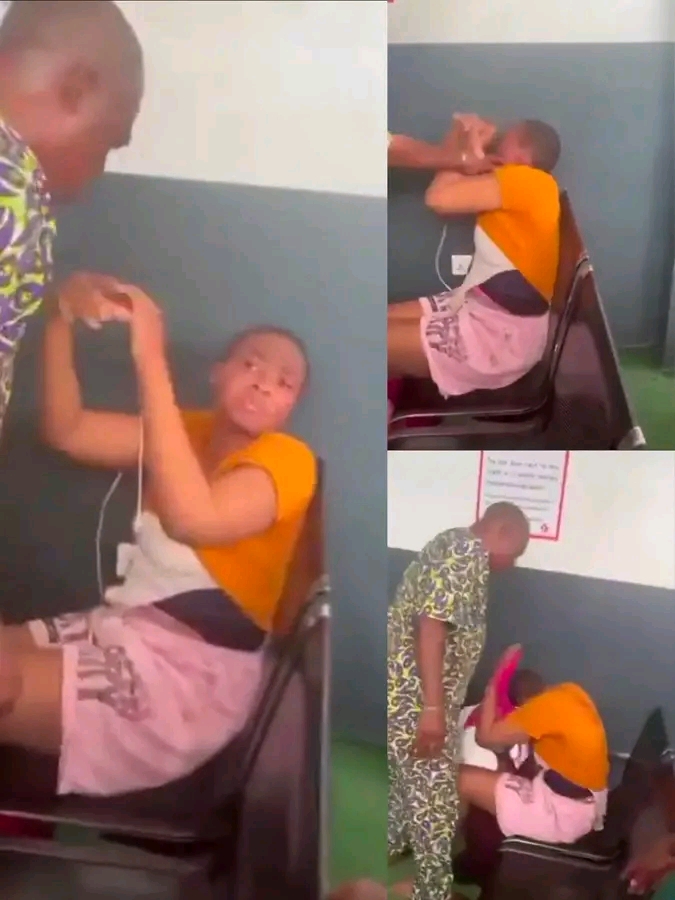

A video circulating online reportedly shows a wife beating her husband while he was sick and attached to an IV drip (a tube that delivers fluids or medicine into a vein). According to the description we received, the husband tried to endure the beating at first. When she did not stop, he pulled out his IV line and began fighting back. We could not verify the video, and the identities of the couple, the place and the date are not known. We also do not know what led to the confrontation, whether the husband was in a hospital or at home, or whether anyone intervened. Both people are presumed innocent of any wrongdoing until the facts are known, and a short clip cannot show the full story.
Men Report Abuse More Often Than Many Realise: Lagos Figures and Past Cases (Earlier Reports of Domestic Violence Against Men)
Government figures show that domestic violence against men is a real, if less discussed, problem. In 2017, the Lagos Attorney General said 55 husbands had reported being battered by their wives between January and September of that year, against 14 the year before. In the first half of 2021, the Lagos State Domestic and Sexual Violence Response Team said 194 men were reportedly assaulted by their partners, 44 percent more than in the same period of 2020.
The numbers have kept rising. Lagos State’s Domestic and Sexual Violence Agency (DSVA) said 340 men reported being beaten by their wives between September 2022 and July 2023, more than twice the figure for the previous year. Between November 2024 and November 2025, the agency recorded 920 male gender-based violence cases, of which 437 involved domestic violence. Its head said the rise reflects progress against stigma, because more men are speaking up. These are cases reported in one state, and many more probably go unreported.
Women are still the majority of victims. A ThisDay editorial noted that spousal abuse cuts across both sexes, but women are predominantly the victims in Nigeria, and many do not report out of fear of stigma. Both statements are true, and neither cancels the other.
Why Some Victims Stay Silent and Some Fight Back: Pressures Behind Closed Doors (Possible Causes and Barriers to Reporting)
We cannot say what drove this couple’s conflict, so we will not guess. What research and officials say is that stigma keeps many male victims quiet. The head of Lagos’s response team said that when a man experiences violence, even other men mock him, so he does not speak up. A marriage counsellor quoted by one analysis blamed the stress of city life, arguing that men often have outlets for it while women generally do not, which can raise tension at home. That is one person’s view, and it should not be treated as an excuse for violence.
Another barrier is the belief that violence laws protect only women. Counsellors have noted that some men might report if they knew the same rules that protect wives also protect them. A Lagos official has also said that in domestic violence cases, many survivors do not want prosecution, only for the abuse to stop.
Danger for Both People, and for Those Who Watch: Effects of Violence at Home (Consequences)
The first effect is on health. If the video is accurate, a sick man was being hit while he needed treatment. Pulling out an IV line during a fight can cause bleeding and interrupt his care, and both people could be hurt. A confrontation like this can also escalate quickly.
The second effect is emotional. Abuse from a spouse leaves shame and fear, whoever the victim is. The UNILAG official quoted by the DSVA noted that male victims can suffer emotional abuse, financial pressure and mental health effects.
The third effect is on anyone else in the home. If children are present, they may carry the memory for years. We do not know whether any were present.
For the country, the cost is a society that treats violence as entertainment or as a matter of “who is stronger.” Lagos’s agency has said that men and boys can be victims too, and that the aim of its outreach is to reduce stigma and encourage reporting. When clips like this go viral without context, the real people in them can be mocked and their problems forgotten.
Answering Violence Without Adding More: What Couples, Bystanders and Hospitals Can Do (Possible Solutions)
If you are in a violent home, the safest course is to leave the room if you can, call a trusted relative or neighbour, or contact the police or your state’s domestic violence agency. Hitting back may feel natural, but it can lead to injury, to counter-accusations or to arrest. We say this without blaming anyone in the video, because we do not know what happened.
Bystanders can step in safely. Anyone filming a fight should consider calling for help instead, and anyone who sees a patient being attacked should alert hospital staff, security or the police. Sharing a video of a private fight can humiliate those involved, so think carefully before posting it.
Couples can seek help early. Marriage counselling, family mediation and religious leaders can help before arguments become violent. Counsellors have called for stronger support services for both husbands and wives.
Government and hospitals have roles too. Lagos has set up the DSVA and a campaign on violence against men, “The Hidden Crime,” to encourage reporting. Other states can copy this, and clinics can train staff to spot and report abuse of patients. Laws such as the Violence Against Persons (Prohibition) Act 2015 exist, but ThisDay noted that reports of abuse appear almost daily despite them, so enforcement matters.
No Home Should Be a Place Where Illness Invites Violence: Our Closing Reflection (Compassion, Fairness and Accountability)
We make no judgment on the couple in this video. A clip shows a moment, not the history, and the people in it deserve a chance to tell their own story.
But we say plainly that violence against a sick person, by anyone, is wrong. We also say that violence against men is real, and that the numbers in Lagos show more of them are now speaking out. At the same time, women remain the majority of victims, and a viral clip should never be used to dismiss their pain.
We urge Nigerians to resist laughing at abuse, whoever the victim is. If you or someone you know is being hurt at home, speak to someone you trust, a counsellor or your state’s domestic violence agency. We will update this report if the people in the video or the authorities come forward.
Published by Ejoh Caleb