
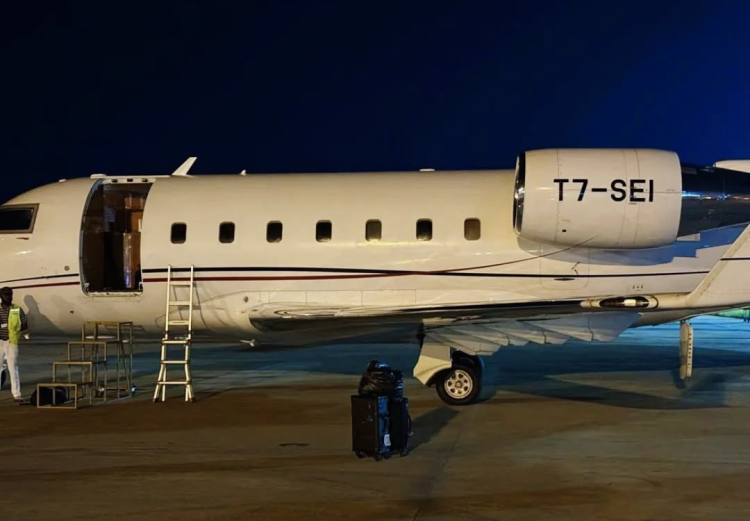
A private jet operated by Triton Aviation lost a door shortly after taking off from Nnamdi Azikiwe International Airport, Abuja, on Thursday, October 15, 2026. The crew declared a Mayday (the international call for a life-threatening emergency) and returned safely to the airport. The aircraft was a CL60, part of the Bombardier Challenger 600 family, with registration number T7-SEI and flight identification DWC052. It was flying from Abuja to Murtala Muhammed Airport, Lagos.
According to a serious incident report cited by several outlets, the aircraft left Runway 22 at 1617 UTC, which was 5:17 p.m. Nigerian time. At 1620 UTC, about three nautical miles out and climbing through 3,000 feet, the crew made the Mayday call and reported an open door. Air traffic control sent the aircraft back to Abuja for an emergency landing. The airport’s emergency and medical teams were placed on standby, and the plane landed about 14 minutes after the distress call. The report says the duty controller could not see the door from the tower because of the aircraft’s position. After landing, the controller saw that the door was missing from the fuselage.
What Is Known and What Is Not: The Investigation Has Only Just Begun (Official Response and Open Questions)
The Nigerian Safety Investigation Bureau (NSIB) confirmed the serious incident and said investigators had been deployed. The Nigeria Civil Aviation Authority (NCAA) also confirmed it but said the NSIB has jurisdiction. As of the reports we found, the NSIB had not announced a preliminary cause, and Triton Aviation had not responded publicly.
A video has also circulated, showing people who say they found the missing door on farmland in the Abuja area. We could not verify the video or confirm that the object is from this aircraft. The reports did not say how many people were on board or whether anyone was hurt, and we will not guess.
Nigeria’s Recent Incidents Show a System Under Close Watch: Past Cases and Lessons (Earlier Aviation Occurrences)
This is not Nigeria’s only recent aviation scare. On June 10, 2026, a Bombardier Challenger 601-3A operated by VMO Aero, a jet from the same wider family, mistakenly landed on a road under construction near Asaba Airport. The NSIB’s preliminary report recommended stronger emergency response procedures, better coordination among aviation agencies and more reliable recording of air traffic communications.
On July 23, 2026, an Enugu Air Embraer E170 overran the end of the runway at Benin Airport. Everyone on board was evacuated and no injuries were recorded. The NSIB’s preliminary report faulted poor navigation aids and weather equipment at the airport and called for the removal of old structures beyond the runway end. The Federal Airports Authority of Nigeria (FAAN) urged the public to let facts land first and noted that no aviation system in the world can promise zero incidents. Both cases show that Nigerian investigators publish findings, and that these findings often point to wider gaps.
A famous door-related case abroad shows what a full investigation can uncover. In January 2024, a door plug (a panel that fills an unused emergency exit) blew out of an Alaska Airlines Boeing 737 MAX 9 shortly after take-off. The US National Transportation Safety Board found that the plug was missing four critical bolts, and its final report blamed Boeing for failing to give workers adequate training and oversight. That case involved a different aircraft and a different kind of door, and we are not saying the Abuja incident has anything in common with it. It only shows that investigators can trace a door loss back to maintenance and oversight, not just a single mistake.
Why a Door Might Come Off in Flight: What Investigators Will Look At (Possible Causes Under Investigation)
We cannot say why this door came off, and only the NSIB can. In general, investigators in such cases look at several areas. These include how the door was closed and latched before departure, the condition of its locking parts, the aircraft’s maintenance records and any recent work on the door, and whether warning signals appeared in the cockpit. They also review crew actions and the flight data. This is typical of door-loss investigations, and we are not suggesting any of these was the cause here.
The Alaska case shows how serious a hidden maintenance problem can be, as that investigation found the bolts were removed during factory repairs and never replaced. For private and charter aircraft in Nigeria, the NSIB’s earlier findings on the Asaba incident also pointed to the importance of reliable communications and coordination.
A Safe Landing, but Real Risks: Effects on Passengers, People on the Ground and Public Confidence (Consequences of the Incident)
The first effect is on those on board. A door opening in flight is frightening, and a loss of cabin pressure and sudden wind noise can be dangerous. The aircraft was at about 3,000 feet, a low altitude that is far less severe than at cruising height. We have no information on the passengers or crew’s condition.
The second effect is on people on the ground. A heavy door falling from 3,000 feet can hurt anyone beneath it, and reports say the door reportedly landed on farmland. Part of the answer to what happened may lie in that door, so it matters that it is handled properly.
The third effect is on public confidence. Nigeria has had several scares in 2026, and each one prompts questions about oversight. The FAAN’s own statement says that the true measure of aviation safety is how the system responds. In this case, air traffic control, the crew and the emergency teams reportedly acted quickly.
For the country, private and charter flying is a part of the aviation sector that people rarely see. How well it is monitored affects safety for business travellers, officials and others who use it, and for those below the flight path.
Keeping the Skies Safe After a Close Call: Practical Steps for Operators, Regulators and the Public (Possible Solutions)
First, the facts should come out. The NSIB has said it normally releases a preliminary report within 30 days of an investigation starting, as it did in the Enugu Air case. It should publish this one on time and in plain language, and Triton Aviation should cooperate and speak to the public when it can.
Second, anyone who finds a part of the aircraft should not move or keep it. They should report it to the police, the airport authority or the NSIB, so that investigators can examine it where it fell. This is our suggestion, based on how accident evidence is normally handled.
Third, the regulator can check similar aircraft and operators. The NCAA could review door-latching and maintenance practices for other jets of the same type and for charter operators, once the NSIB identifies what went wrong.
Fourth, operators can reinforce pre-flight checks, including a second person confirming that doors are properly closed, and make sure maintenance records are complete and available.
Fifth, the public and the media should be careful with speculation. The NSIB has urged people to let investigators finish their work.
A Safe Return Is Good News, but It Is Not the End of the Story: Our Closing Reflection (Safety, Transparency and Patience)
We are relieved that the aircraft returned safely and that no injuries were reported in the accounts we saw. The crew’s quick Mayday call, the controllers’ response and the standby emergency teams all appear to have done their jobs.
But a door should not come off a plane in flight, and the public is right to want answers. Until the NSIB reports, no one should blame the crew, the operator or any maintenance team. Facts must come first.
We urge the NSIB to publish its findings promptly and Triton Aviation to cooperate fully. We also urge regulators to ask whether private and charter flights get the same level of scrutiny as scheduled airlines. We will update this story when the NSIB or the operator releases more information.
Published by Ejoh Caleb