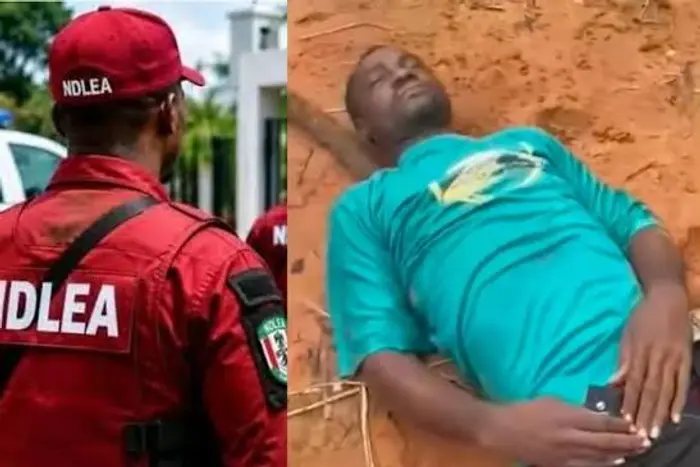
An officer of the National Drug Law Enforcement Agency (NDLEA), not yet publicly identified, drowned on Saturday, September 19, 2026, while chasing a suspected drug offender who jumped into the Ethiope River at Obiaruku, in the Ukwuani Local Government Area of Delta State. According to community sources, NDLEA operatives had apprehended the suspect and were escorting him toward the River Ethiope Bridge when he broke free and leapt into the water in an attempt to escape. At least two officers followed him into the river; one was rescued and taken to hospital for treatment, while the other drowned. The suspect and others reportedly being pursued escaped through the river, and the officer’s body was later recovered from the water.
Before the remains could be released to NDLEA authorities, the Obiaruku community reportedly required that traditional rites associated with drowning deaths be performed, which local sources said included the provision of a goat and other specified items. One source close to the incident described the drowning as puzzling, noting that the section of the river involved was not generally considered deep enough to kill a person, which has fed speculation about exactly what happened once the officers entered the water. As of the time of reporting, the identities of the deceased officer, the surviving officer and the suspect had not been officially released. The Delta State NDLEA Commander, Halilu Hamidi, referred inquiries to the agency’s spokesperson, Femi Babafemi, who did not respond to calls, while a senior NDLEA official confirmed the incident and said an investigation was ongoing. The Delta State Police Public Relations Officer, Bright Edafe, separately appealed for calm.
Nigerian Security Operations Have Ended in Drowning Before, and Recently (Similar Cases in Nigerian Law Enforcement)
This is not an isolated tragedy, and it is not even the first drowning connected to a Nigerian security operation in Delta State this year. In May 2026, a member of the Nigeria Forest Security Service and a civilian both drowned during a joint patrol operation in the state, after the civilian ran into an uncompleted building to escape and the pursuing officer followed him inside, where both men accidentally fell into an abandoned open well. That case, like this one, involved an officer following a fleeing suspect into a hazard neither of them could fully see, with fatal consequences for both the pursuer and, in that case, the pursued.
A similar pattern played out in Oyo State in July 2020, when two newly recruited police constables and a member of a community security group drowned while chasing suspected drug users near a bridge that had been washed away by flooding. The suspects had run into the water, and the pursuing officers followed one of them in, only to be pulled under by mud in the riverbed. In both of these earlier cases, as in the Ethiope River incident, the fatal decision was the same: officers entering unfamiliar and hazardous terrain in pursuit of a suspect, without a clear picture of what lay beneath the surface.
Why Officers Keep Following Suspects Into Water They Cannot See Into (What Drives These Fatal Pursuits)
The immediate cause of Saturday’s drowning was straightforward: a suspect escaped into a river, and officers pursued him without knowing the river’s depth, current or hidden hazards at that specific point. Policing experts who study water rescues note that entering open water in pursuit of a fleeing person, especially while wearing duty gear, carries serious risk even for trained swimmers, since equipment and clothing can drag an officer down in ways that are not obvious until it is too late.
The deeper cause is a gap in how Nigerian security agencies prepare officers for exactly this kind of scenario. Nowhere in the reporting on this incident, or on the similar Delta State and Oyo State cases before it, is there any mention of officers being equipped with life jackets, ropes or other basic water-rescue tools, or of water safety training being part of standard operational preparation for agencies like the NDLEA. International policing guidance stresses that officers should never enter water to complete a pursuit without proper training and equipment, precisely because doing so risks turning a single emergency into two. Without that kind of standard preparation, officers working near rivers, creeks and waterlogged terrain across Nigeria’s many riverine states are left making split-second decisions about entering water with no formal guidance on when to stop.
The Cost to One Family, and to Nigeria’s Record on Water Safety (Individual and National Effects)
For the officer’s family and colleagues, this is a life lost in the course of ordinary drug enforcement duty, a job that, on paper, does not typically require officers to be capable swimmers or trained in water rescue. Beyond the immediate loss, incidents like this add pressure on NDLEA morale, since officers reasonably expect that their agency has prepared them for the hazards they are likely to encounter, and a river chase turning fatal suggests that preparation may fall short in practice.
Nationally, this incident fits into a much larger pattern. Drowning kills roughly 66,000 people across the African region every year according to the World Health Organization, and Nigeria has specifically committed to strengthening its coordination on drowning prevention as part of a broader regional push. Most of these deaths occur in exactly the kind of setting seen here: rivers, lakes and other open water in a country where formal swimming instruction and water rescue training remain limited outside a handful of state-level and federal aquatic programmes. Every officer who drowns in the line of duty adds to that toll and raises the same unanswered question about whether Nigeria’s security agencies are adequately preparing their personnel for the country’s waterways.
What Could Prevent the Next Officer From Drowning (Possible Fixes for Water-Related Operational Risk)
The most direct fix is training. Policing bodies elsewhere recommend that officers working in any area with significant water exposure receive dedicated water safety and survival training, including how to move and swim while wearing duty gear, when to abandon a pursuit rather than enter open water, and how to perform a rescue without becoming a second victim. For an agency like the NDLEA, which regularly conducts operations in riverine states such as Delta, Rivers and Bayelsa, this kind of training could plausibly be built into standard operational preparation rather than left to individual officers’ judgment in the moment.
Basic equipment is a second, more immediate fix. Recommended tools for officers working near water include a rope for throwing or tying off, and a personal flotation device that can be kept in a patrol vehicle and worn whenever operating near a body of water. None of the reporting on this incident suggests either was available to the officers involved. A clear operational policy on when officers must break off a pursuit rather than enter unfamiliar water, similar to policies some police agencies elsewhere have adopted after losing officers to drowning, could also help prevent a repeat of what happened at Obiaruku.
A Life Should Not Be the Price of Catching One Suspect
We think this officer’s death deserves to be treated as more than a single unfortunate accident. Set beside the Delta State well drowning in May and the Oyo State river drowning in 2020, a pattern starts to emerge: Nigerian security personnel entering water or water-adjacent hazards in pursuit of fleeing suspects, with no clear evidence of training or equipment designed to protect them if the pursuit goes wrong.
We understand the instinct to chase a fleeing suspect; it is, in a real sense, the job. But we do not think that instinct should be left unsupported by basic safety measures that could mean the difference between a successful arrest and a funeral. An agency that sends officers into Nigeria’s riverine communities owes them, at minimum, training and equipment matched to that environment.
We extend our condolences to the officer’s family and colleagues, and we hope the NDLEA’s promised investigation looks honestly not just at what happened in the water on Saturday, but at whether this officer, like those before him, was ever given a real chance to survive it.
Published by Ejoh Caleb