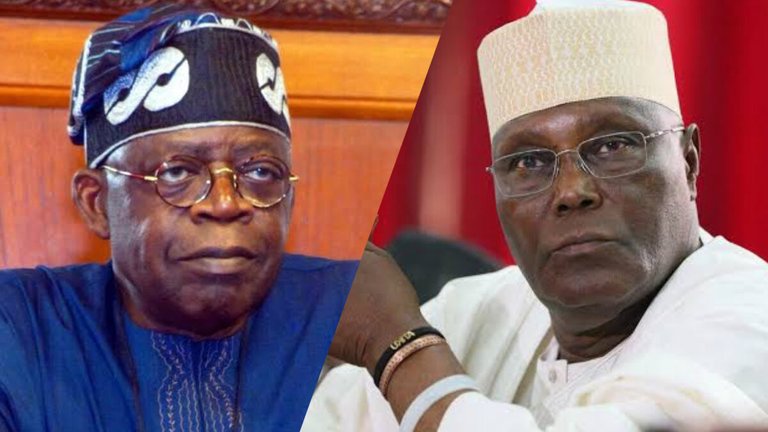
Former Vice President Atiku Abubakar has claimed that President Bola Tinubu is 90 years old and in poor health, saying he possesses evidence he is prepared to present in court. Atiku made the claim in an interview with the BBC published on Friday, while defending his decision to contest the 2027 presidential election under the African Democratic Congress (ADC).
“You have a President who is 90 years old now and sick, and I am healthy and strong. So why won’t I make myself available to serve my country? You went and voted for someone who is 90 years old. I have evidence that President Tinubu is 90 years old, and I will present it in court,” Atiku said. The BBC interviewer pushed back in real time, telling him Tinubu is not yet 90 and that the network could neither confirm nor deny the president’s exact age. Atiku maintained his position, repeating that he has evidence and would present it in court if necessary.
According to official records, Tinubu was born on 29 March 1952, making him 74 years old, and he has previously defended those records as consistent across his school transcripts and public office documents. Atiku, who will be approaching 80 by the time Nigerians next go to the polls, brushed aside questions about his own age in the same interview, responding “do I look to you like someone who has reached 80 years of age?” when corrected on Tinubu’s actual age.
A clip of the exchange has been circulating widely online.
A Familiar Fight: Age And Identity Disputes Keep Trailing Nigerian Politicians
Age controversies are nothing new in Nigerian politics, and Tinubu himself has faced them before. Ahead of the 2023 election, critics speculated that he was significantly older than his official records showed, with some claiming he was 79 or even 89. Tinubu addressed the allegations directly at a Chatham House event in London, insisting his birth records, school transcripts and university documents were all consistent, and even offered to undergo a DNA test to settle the matter. The controversy was fuelled partly by a 1999 form he submitted to Nigeria’s electoral commission that listed a different birth year than his other records, an inconsistency his campaign later attributed to a clerical error.
Nigeria has a longer history of politicians’ personal records being questioned or falsified outright. In 1999, then-Speaker of the House of Representatives, Salisu Buhari, resigned and was later convicted after it emerged he had lied about both his age and his university qualifications. Disputes over politicians’ true ages, certificates and even citizenship have recurred in Nigerian elections ever since, partly because many older Nigerians, including some of the country’s most prominent leaders, were born at a time when birth registration was not consistently practiced, leaving room for records to be disputed decades later.
Why These Claims Keep Working — And What They Cost Nigeria’s Politics
Claims like this spread easily in Nigeria partly because the country’s civil registration system has historically been weak, especially for citizens born in the 1940s and 1950s, before birth certificates were consistently issued or preserved. That gap makes it difficult to definitively prove or disprove a politician’s age using paperwork alone, which leaves room for accusations to linger regardless of the truth.
Politically, the timing of Atiku’s claim is no accident. It surfaces as he prepares for another presidential run in 2027, using Tinubu’s age as a way to deflect scrutiny of his own, since Atiku himself will be nearing 80 by election time. For ordinary Nigerians, disputes like this carry a real cost. They pull public attention away from the issues both men claim to care about, insecurity, the economy and fuel prices, and toward a personal dispute that, without hard evidence, neither side can easily resolve. For Nigeria as a country, the repeated resurfacing of unresolved age and identity disputes involving its top leaders feeds a wider culture of unverifiable claims in public life, making it harder for citizens to separate genuine accountability questions from political point-scoring.
Settling These Disputes Would Take More Than A Press Conference
If Atiku genuinely possesses documentary evidence of Tinubu’s age, legal experts note that a court challenge would need far more than a public claim: it would require authenticated birth or school records, which have proven difficult to produce definitively in past Nigerian age disputes, including Tinubu’s own in 2023. Until such evidence is formally presented and tested, the claim remains an unproven political accusation rather than an established fact.
More broadly, strengthening Nigeria’s national identity and civil registration systems, so that every citizen’s age and identity can be verified through modern, tamper-resistant records, would help prevent these disputes from being litigated in public opinion rather than in fact. Media houses and fact-checkers also have a role to play in clearly separating verified records from political claims when covering stories like this one, rather than repeating allegations without context.
A Distraction Dressed Up As A Revelation
There is a familiar rhythm to moments like this in Nigerian politics: a serious allegation, thrown out in an interview, promises of evidence that may or may not ever appear in a courtroom, and days of public debate that produce more mockery than clarity.
We think Nigerians deserve better than another unresolved shouting match over who is really how old. Whether Tinubu is 74 or 90 does not fix the price of fuel, does not create jobs, and does not make the country safer. If Atiku truly has evidence, he should present it and let the courts decide. Until then, we would rather see both men, and the rest of Nigeria’s political class, spend their energy on the problems that Nigerians actually feel every day.
Published by Ejoh Caleb