
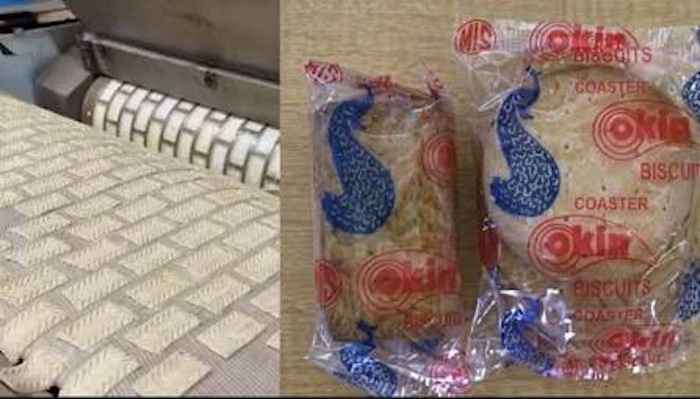
Okin Biscuits, one of Nigeria’s most fondly remembered snack brands, has resumed production for the first time in 17 years. Biscuits rolled off one of the company’s rehabilitated production lines at its factory in Offa, Kwara State, on Wednesday, in what the company called a major step toward returning its products to Nigerian shelves.
The company announced the milestone on its official Facebook page, explaining that the production line had to be rebuilt almost from scratch. Cables, frequency drives (electronic devices that control the speed of factory machines), contactors and motors had all been stolen from the factory during the years it sat idle, leaving the facility unable to run. Okin said further testing, calibration and rehabilitation work is still needed before the familiar Okin taste and quality can be fully restored and full-scale production can begin.
A video showing the factory’s revived production line has been circulating online.
A Brand Built On One Man’s Vision, Undone By Years Of Decline
For Nigerians who grew up in the 1980s and 1990s, Okin Biscuit was more than a snack. It was a familiar presence in school bags and a treat often shared among friends and classmates. The brand was built by Chief Emmanuel Olatunji Adesoye, an industrialist from Offa who became the first qualified quantity surveyor in Northern Nigeria and went on to champion local industrialisation and job creation.
But the factory eventually fell victim to a mix of competition from imported biscuits, poor management and a changing economy, forcing it to shut down years ago. By 2017, the property was reportedly listed for sale, with little hope of the factory ever running again.
Okin’s story mirrors a much bigger pattern in Nigeria. The country’s textile industry, once Africa’s third-largest, collapsed from around 175 mills in the 1980s to only a handful still operating today, a decline blamed on cheap imports, smuggling, unreliable electricity and outdated machinery. Over 820 Nigerian companies shut down or suspended production between 2000 and 2008 alone, according to the Manufacturers Association of Nigeria. Okin Biscuits is one small part of a much longer story of Nigerian factories that went silent.
What Killed The Factory, What’s Bringing It Back, And What It Means For Nigeria
Okin’s collapse followed a pattern common to many Nigerian manufacturers: cheaper foreign competition undercut local prices, management struggles piled up, and once the factory went idle, it became a target for theft, with thieves stripping out the very equipment needed to restart it. Its eventual revival came only after the Kwara State Government stepped in as part of a broader economic development push, funding the rehabilitation of the factory and installation of modern production equipment.
The effects of the closure were felt well beyond the factory gates. Years of inactivity left many residents of Offa and Ijagbo unemployed and hurt local businesses that once depended on the factory for trade. Now, its return is expected to create hundreds of direct and indirect jobs and boost commercial activity in the area.
For Nigeria as a whole, Okin’s return matters beyond one factory or one town. It fits into the country’s wider push to revive local manufacturing and reduce dependence on imported goods, at a time when Nigeria’s manufacturing sector has struggled for decades with factory closures, job losses and lost industrial capacity. Every dormant factory that restarts is a small sign that Nigeria’s manufacturing base, badly weakened over the past few decades, can still be rebuilt.
Keeping The Machines Running Will Take More Than Reopening Them
Industry observers note that reopening the factory is only the first challenge; keeping it running profitably is another. Nigeria’s biscuit market has changed considerably in the 17 years Okin was away, with several local and foreign brands now firmly established, meaning Okin will need to fight hard to win back shelf space and consumer loyalty.
The broader lesson from Nigeria’s manufacturing decline is that revival efforts only succeed with sustained support: reliable electricity so factories don’t depend on costly diesel generators, affordable financing for machinery and raw materials, and stronger enforcement against the smuggling of foreign goods that undercut local producers. Without addressing those underlying problems, experts warn, revived factories risk sliding back into the same struggles that shut them down in the first place.
A Small Victory Worth Celebrating, Cautiously
There is something genuinely heartwarming about seeing Okin’s machines running again. For a generation of Nigerians, this is a childhood memory coming back to life, and for the people of Offa and Ijagbo, it is a chance at jobs and income that had been missing for 17 years.
Still, we think it is worth celebrating this milestone with open eyes rather than pure nostalgia. Nigeria has watched too many revived factories and grand industrial promises fade quietly once the initial excitement wears off. Okin’s real test will not be the day biscuits first rolled off the line, but whether the company, and the government backing it, can fix the deeper problems, power, financing, unfair competition, that shut the factory down in the first place. If they can, Okin’s comeback could be a genuine template for reviving Nigeria’s many other silent factories, not just a nostalgic moment.
Published by Ejoh Caleb