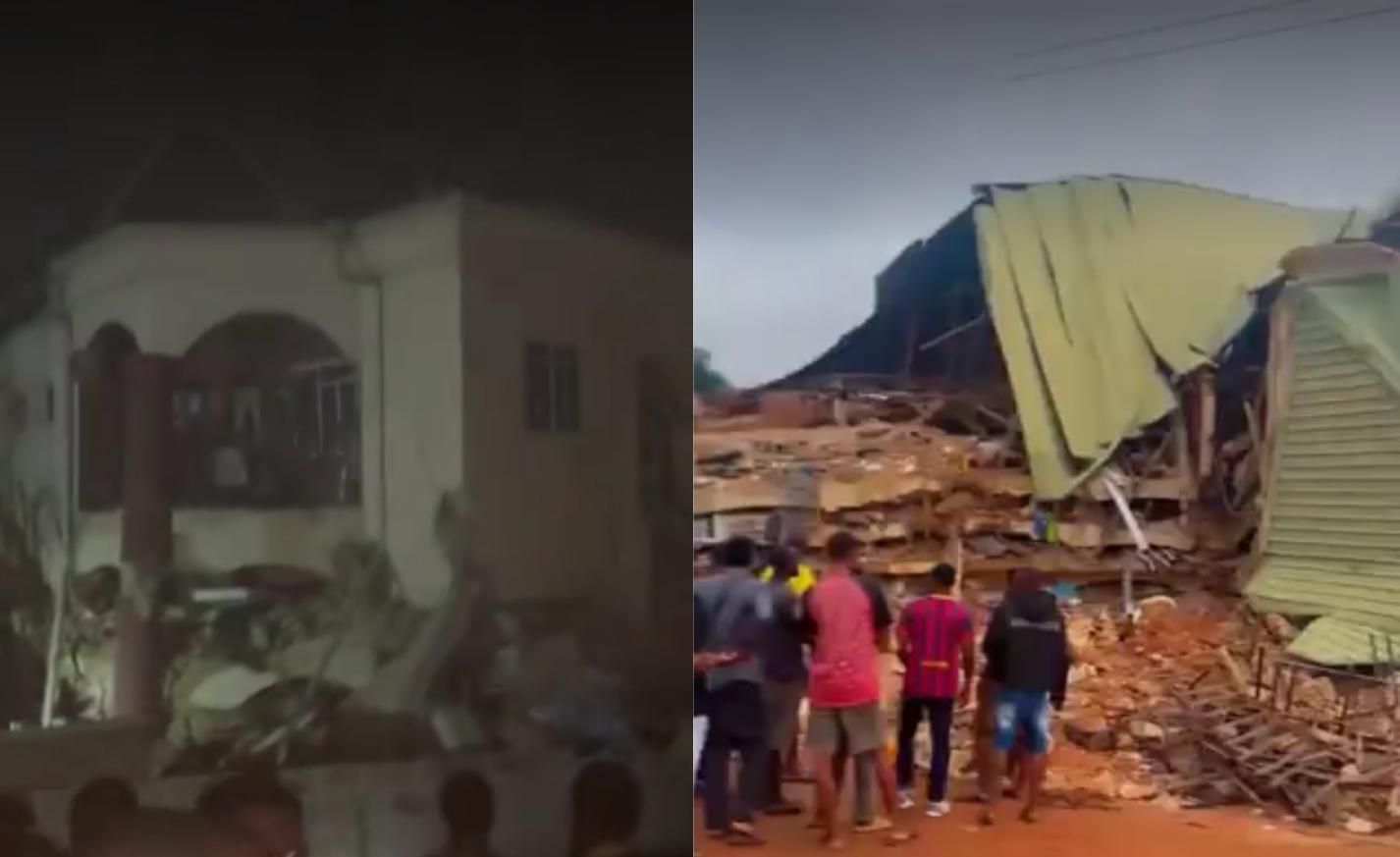
A three-storey private student hostel, known as Elite Five Star Lodge, has collapsed in Amaokpala, Oko, in Orumba North Local Government Area of Anambra State. The building, located beside Tonimas Filling Station near the Federal Polytechnic, Oko, caved in late on Sunday night, July 26, trapping an unknown number of occupants beneath the rubble.
Eyewitnesses said they heard a loud bang moments before the structure gave way, sending residents and students rushing to the scene in panic. The Anambra State Police Command, working alongside the Anambra State Fire Service and the State Emergency Management Agency (SEMA), launched a rescue operation shortly after receiving a distress report. Police spokesperson SP Tochukwu Ikenga confirmed that operatives secured the area and coordinated rescue efforts with other emergency agencies.
As rescue work continued into Monday, three students were pulled out of the rubble alive and taken to St. Michael Hospital, Oko, for treatment, while search teams kept combing through the debris for anyone still trapped. The Federal Polytechnic, Oko later issued a statement clarifying that the collapsed building was a privately owned lodge occupied by both students and non-students, and was not located within the school’s campus. The institution’s spokesperson, Dr Oguegbu Udoka, said no student of the polytechnic had been confirmed dead, adding that most students had already left for home after completing their second-semester examinations, and that the two people still believed trapped were reportedly not students of the institution.
A tragedy Nigeria keeps repeating
This is far from Nigeria’s first deadly building collapse, and unfortunately, it is unlikely to be the last. Between 2022 and September 2025 alone, Nigeria recorded about 145 building collapse incidents nationwide, with Lagos State accounting for roughly half of them.
The country’s most infamous recent case remains the 21-storey building collapse in Ikoyi, Lagos, in November 2021, which killed 46 people, including the developer himself, and shocked the nation into renewed debate about construction standards.
According to the Nigeria Building and Road Research Institute (NBRRI), the country recorded over 200 building collapses between 2020 and 2025, resulting in more than 126 deaths, with the most common cause being the use of substandard construction materials.
Why buildings like this keep coming down
Experts point to a combination of factors behind Nigeria’s building collapse crisis: the use of substandard or defective materials, poor or non-professional design, inadequate soil and foundation testing, and the widespread use of unqualified builders instead of certified professionals.
Weak enforcement of building codes plays a major role too. Regulatory bodies exist on paper, but compliance is often inconsistent, allowing developers to bypass approvals, alter designs mid-construction, or skip proper supervision entirely, especially for privately owned buildings like student hostels that spring up quickly around universities and polytechnics to meet housing demand.
How this affects students and Nigeria as a country
For the students and residents living in Amaokpala, this collapse is a direct threat to life and safety in a space they trusted to be secure. Even those who escaped injury now face the trauma of having lived through, or witnessed, a building falling apart around them.
Beyond Oko, incidents like this erode public confidence in off-campus student housing across Nigeria, where many tertiary institutions cannot provide enough hostel space and push students toward privately built, and often poorly regulated, lodges. At the national level, each new collapse adds to Nigeria’s troubling global reputation for weak construction oversight, a pattern that discourages serious real estate investment and raises hard questions about how state governments monitor buildings that house some of the country’s most vulnerable young people, students living far from home for the first time.
Possible solutions
State governments, including Anambra State, need dedicated building control agencies with the resources to regularly inspect private hostels and lodges built around tertiary institutions, not just buildings in major commercial cities.
Tertiary institutions should be more actively involved in vetting off-campus housing that their students rely on, even when those buildings sit outside the official campus boundary.
Developers and landlords who cut corners on materials or skip professional certification should face real, enforced penalties, not just public criticism after a tragedy occurs.
Independent structural safety audits should be mandatory before any multi-storey building marketed to students is allowed to open for occupation.
Government at state and federal level should invest in affordable, well-regulated campus housing, so students are not forced to rely so heavily on unregulated private lodges in the first place.
A balanced view: private landlords and weak institutional oversight share the blame
It would be easy to place all the blame on the owner of Elite Five Star Lodge, and questions about how the building was constructed and approved absolutely deserve answers. But the wider pattern of building collapses near Nigerian schools also points to a system-level failure: tertiary institutions and local governments often have no real oversight of the private housing market their students depend on, even though everyone knows students will inevitably live in that housing. Holding one landlord accountable without fixing that larger gap means the next collapse is only a matter of time.
Our thoughts
What stays with me about this one is timing. According to the polytechnic’s own statement, most students had already gone home after their exams, which likely limited the scale of this tragedy. That is not a safety system working, that is luck. If this collapse had happened during a full academic session, the outcome could have been far more devastating. I think Nigerians should be uncomfortable with how much of the outcome here depended on the accident of an exam calendar rather than actual building safety enforcement. Every time one of these buildings falls, we hear the same list of causes: substandard materials, no proper inspection, weak enforcement. The list rarely changes, and until real consequences follow for developers and regulators who cut corners, neither will the outcome.
Published by Ejoh Caleb