
The Public Relations Officer of the Delta State Police Command, Bright Edafe, has stirred widespread reactions online after raising a controversial question:
Should DNA testing be made compulsory at childbirth in Nigeria?
The Alleged Incident in Uvwie LGA
In a post shared on social media, Edafe referenced an alleged case in Uvwie Local Government Area of Delta State, where a man reportedly discovered suspicious messages on his wife’s phone.
According to the account:
The man asked to use his wife’s phone.
While using it, a message allegedly popped up from a mystery man asking, “How are my two kids?”
Shocked, the husband reportedly dug deeper and allegedly found evidence suggesting his wife had multiple sexual partners.
He then conducted DNA tests on their three children.
The results allegedly revealed that none of the children were biologically his.
The man, said to be over 50 years old, was reportedly devastated by the outcome.
“It’s Not a Police Case”
Edafe noted that although the matter caused significant emotional distress, it does not amount to a criminal offense that the police can prosecute.
According to him, attempts were made to report the situation as a police case, but law enforcement could not intervene because:
Infidelity itself is not a criminal offense under Nigerian law.
Paternity disputes are civil matters, not criminal cases.
He ended his post by asking again whether DNA testing should be mandatory at childbirth — a question that has since generated heated debate online.
Public Reactions and Broader Debate
The issue has sparked conversations around:
- Paternity fraud and trust in marriage
- Men’s rights and legal protection
- Privacy concerns
- Cost and feasibility of nationwide DNA testing
- Ethical and religious considerations
Some argue that compulsory DNA testing would protect men from unknowingly raising children that are not biologically theirs. Others believe it could:
- Undermine trust in marriages
- Increase domestic conflict
- Raise human rights and privacy concerns
- Create logistical and financial burdens for families and the government
The Legal Angle in Nigeria
Currently in Nigeria:
- DNA tests are optional and usually conducted privately.
- Paternity disputes are handled in civil courts.
- Police involvement is limited unless there is a related criminal offense (such as fraud or document falsification).
This situation has clearly struck a nerve, especially given the emotional and financial implications of raising children under false paternity assumptions.
Check out post …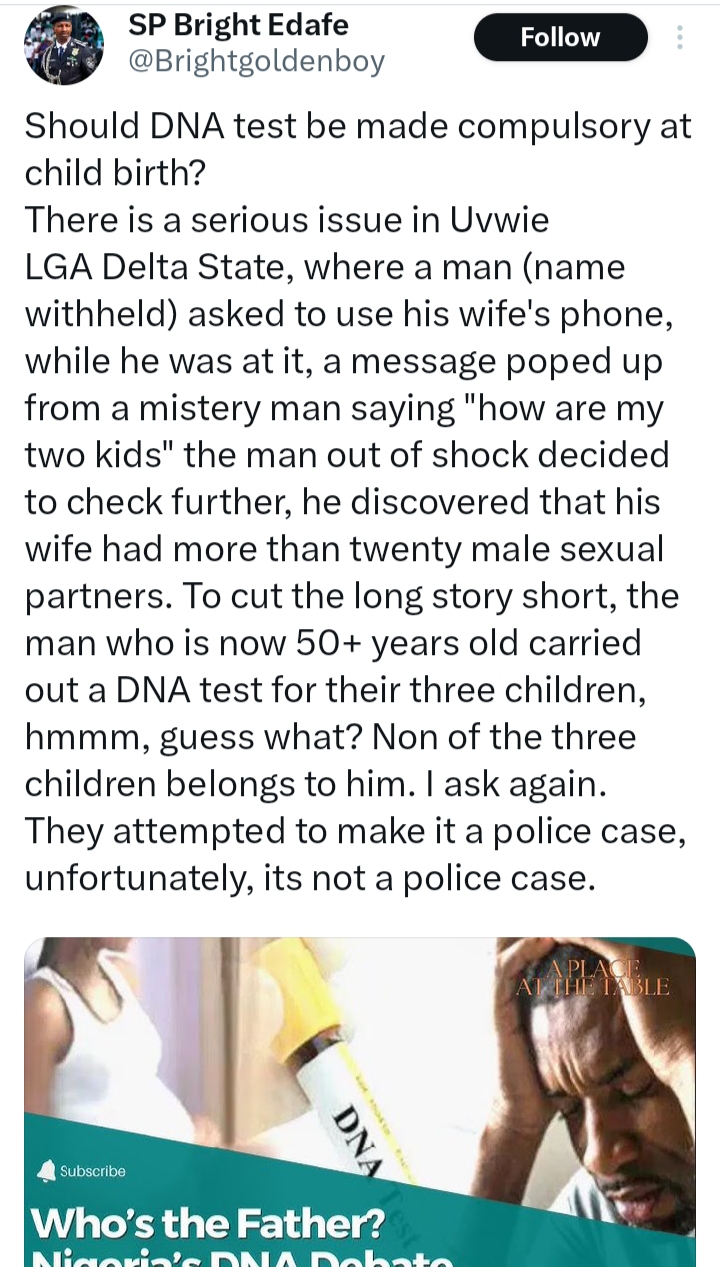
Published by Ejoh Caleb