
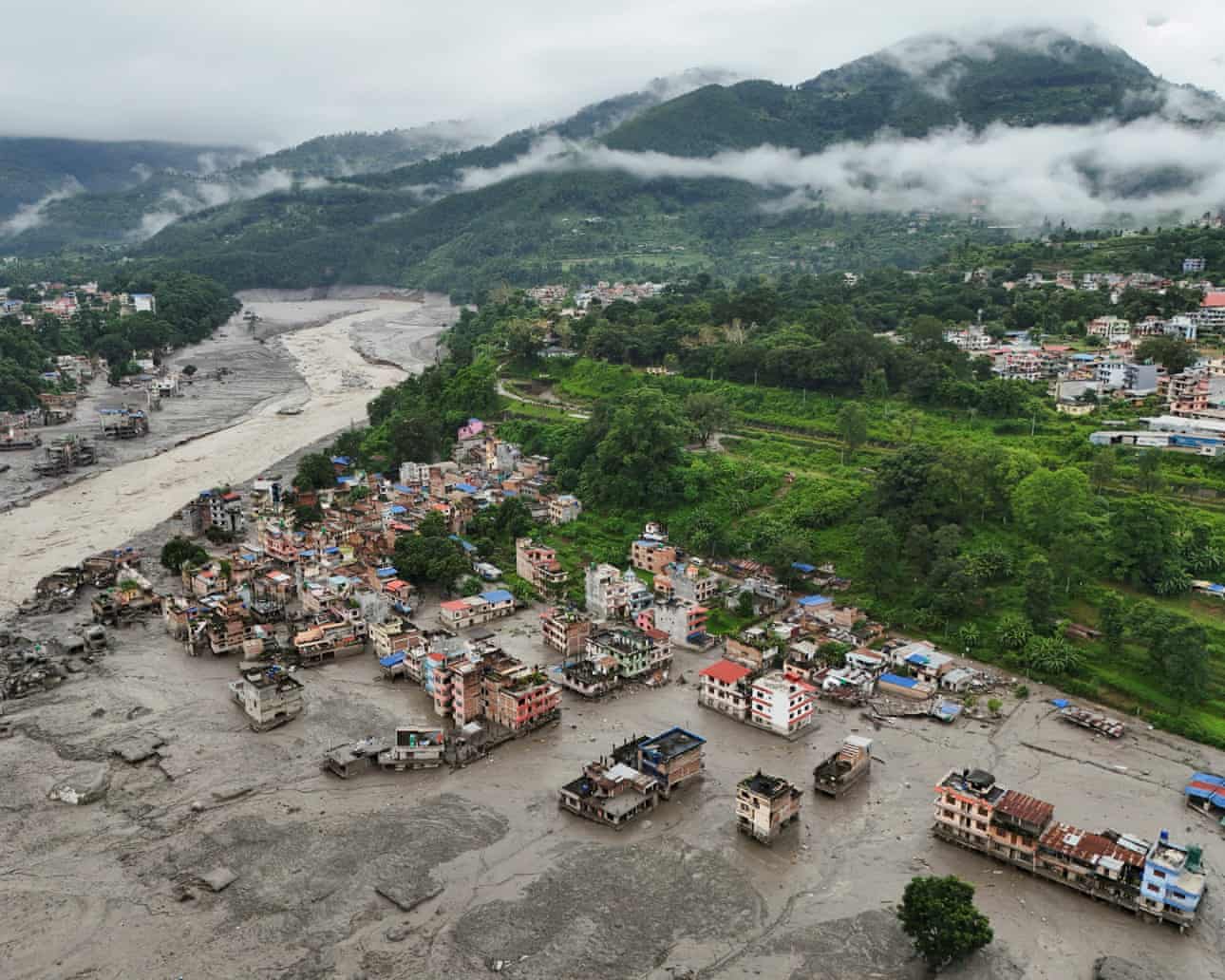
A massive flash flood has torn through mountain villages on Nepal’s border with Tibet, killing at least 177 people and leaving more than 1,300 people missing, most of them foreign tourists. The disaster struck the Rasuwa and Nuwakot districts on Wednesday, sweeping away homes, roads, bridges and power projects along the Trishuli and Bhote Koshi rivers.
Nepalese authorities say the number of people listed as missing in Nepal has risen to 826, including 517 foreign nationals, while at least 558 more remain missing on the Chinese side of the border, including 260 foreigners. Officials warn the death toll is likely to keep rising as rescue teams struggle to reach cut-off valleys. Earlier, Nepal’s tourism board said the missing included Americans, Britons, South Koreans and more than 100 Indian nationals, many caught up while trekking or on pilgrimage routes toward Tibet. In Tibet’s Gyirong county, on the Chinese side of the border, officials say three people have died and hundreds more remain unaccounted for after the flood also struck a major border crossing used by pilgrims.
Rescue helicopters in Nepal are struggling to land in the worst-hit areas because of high floodwaters, while Chinese emergency responders reaching the disaster zone are contending with major roadblocks of mud and debris. The European Union and India have both announced plans to send humanitarian aid, and authorities in India’s Bihar state have begun evacuating people from six districts over fears the floodwaters could reach them next.
A teacher who witnessed the flood in Nuwakot district described watching it sweep away several trucks along with houses and people in its path. The US Geological Survey has since confirmed that a glacial collapse in Nepal’s Rasuwa district triggered the flooding, blocking a mountain river before it suddenly burst and sent a wall of water and debris downstream.
Videos from the scene show the flood tearing through the border area.
A Disaster That Nepal Knows Too Well: Deadly Floods Keep Returning To The Himalayas
Nepal’s mountains are especially prone to this kind of sudden, deadly flooding, and this is far from the country’s first brush with it. In October 2024, floods and landslides across Nepal killed 233 people, while a separate flood in Kathmandu that same year left 101 dead. Just last October, a glacial lake burst its banks in the neighbouring Indian state of Sikkim, destroying a hydroelectric dam and killing dozens of people downstream.
Nepal has also faced this exact kind of glacier-driven flood before, in the very same river system. In July last year, a flash flood in the Bhote Koshi river, downstream of Wednesday’s disaster, was linked to a glacial lake bursting its banks. A similar glacial lake outburst in Tibet triggered a flood in the same border region only a year earlier.
What Triggered This Flood — And The Toll It Is Already Taking, From Nepal To Nigeria
Experts say Nepal’s glaciers are melting and destabilising as global temperatures rise, and that this makes disasters like this one more likely, not less, in the years ahead. Ice and rock breaking loose high in the mountains can dam a river in seconds, only for that same dam to fail without warning, sending a wall of water crashing into towns far below with almost no time to escape.
The human cost in Nepal is already severe: entire families cut off from rescuers, a major highway destroyed, and hydropower stations wrecked in a country that depends heavily on them for electricity. Downstream in India, authorities have issued flood alerts in Uttar Pradesh and Bihar as swollen rivers flow out of the mountains onto the plains.
This kind of disaster should not feel distant to Nigerian readers. Nigeria has suffered its own catastrophic floods in recent years, also worsened by climate change. In 2022, floods killed more than 600 people and displaced 1.4 million Nigerians in the worst flooding the country had seen in a decade. Just last year, flash floods in Mokwa, Niger State, killed over 150 people and left hundreds more missing, while floods in Borno State in 2024 killed 230 people and displaced 600,000. The pattern in Nepal, sudden water overwhelming communities with little warning, is one Nigeria has lived through repeatedly, and climate scientists say both regions can expect it to happen more often as the planet warms.
Warning Systems And Better Planning Could Save Lives Next Time
Disaster experts say the technology to reduce these death tolls already exists. Satellite monitoring can track unstable glacial lakes and warn communities living downstream before they burst, and several Himalayan nations have begun investing in early-warning sensors for exactly this reason. Keeping settlements, roads and hydropower stations further from high-risk riverbanks, and building infrastructure that can withstand sudden flooding, are also seen as key to limiting future damage.
Nigeria has faced repeated calls from its own disaster and climate experts to invest more seriously in flood forecasting, drainage systems and early-warning alerts, especially in flood-prone states, since heavy rainfall and dam releases have caused mass casualties before. The lesson from Nepal this week is the same one Nigeria has already learned the hard way: warning systems and evacuation plans only save lives if they are in place before the water arrives, not after.
A Warning We Cannot Afford To Ignore
It is hard to look at footage of entire villages disappearing under mud and water and not think of Nigeria’s own recent floods, the families in Mokwa and Borno who lost everything in a matter of hours, the same way families in Rasuwa are now searching for missing relatives.
We think disasters like this should push governments everywhere, not just in Nepal, to treat climate-driven flooding as a certainty to prepare for rather than a tragedy to mourn after the fact. Nigeria has already paid a heavy price for being caught unprepared more than once. The question this tragedy in the Himalayas leaves us with is whether that price has to keep repeating before enough is done to stop it.
Published by Ejoh Caleb