
A woman has reportedly confronted her husband after discovering that he allegedly forged his genotype result before their wedding—a deception that led her to undergo two abortions. The revelation has sparked intense debate online about trust, consent, and the consequences of deceit in marriage.
Background
According to the woman’s account:
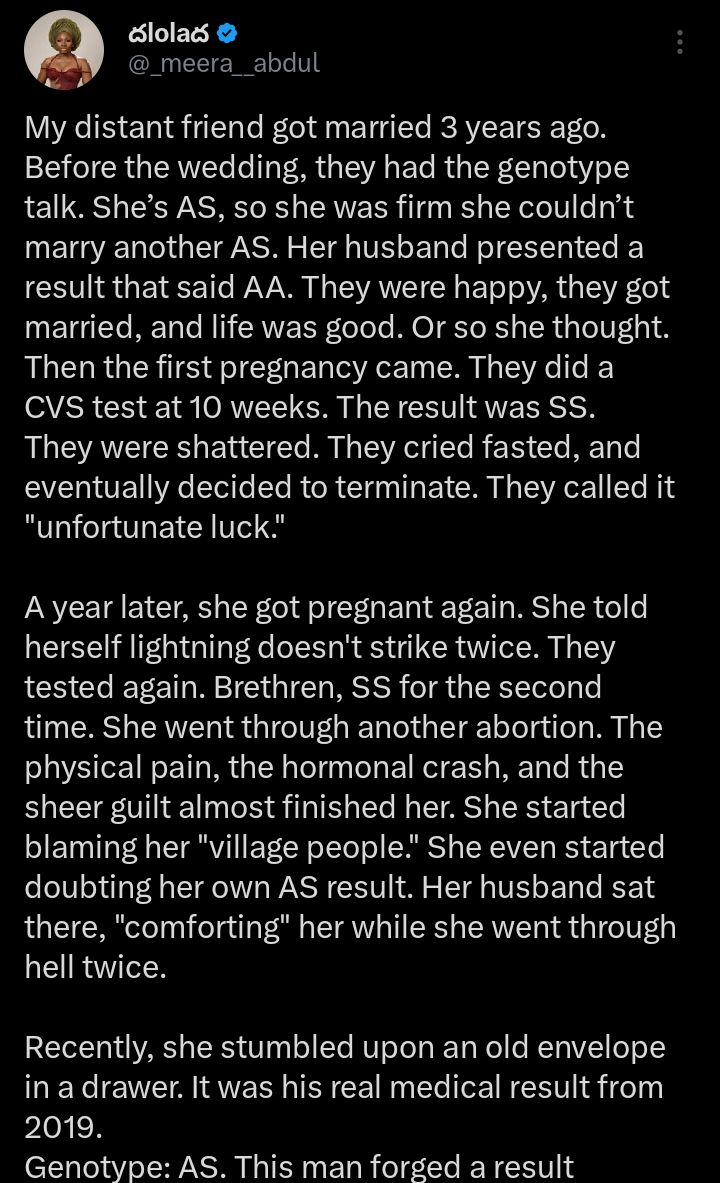
She is AS and had firmly stated before marriage that she could not marry another AS.
Her husband allegedly presented an AA genotype result, and the marriage proceeded.
Tragic Medical Consequences
During her first pregnancy, a CVS test revealed the foetus was SS, prompting a decision to terminate.
The following year, her second pregnancy reportedly resulted in the same diagnosis, and she underwent another abortion.
“My friend sat through two heartbreaking medical procedures because she believed the genotype results were accurate. She endured physical pain, hormonal crashes, and emotional trauma, while he sat there pretending to comfort her.”
Discovery of Deception
The truth came to light when she found an old envelope containing his real 2019 genotype result—AS.
Upon confrontation, the husband reportedly broke down, claiming he forged the result because he didn’t want to lose her.
He allegedly suggested adoption and brought their pastor to encourage her to remain in the marriage, invoking the “for better or worse” covenant.
“She just looks at him like a stranger now. He didn’t just lie about his blood; he sacrificed her womb and her sanity. The question is, can love really justify that?”
Ethical and Emotional Implications
Forging medical results violates trust and denies informed consent.
The deception had serious physical and emotional consequences, including multiple abortions and psychological trauma.
Attempts to invoke religious or marital obligations in the wake of such deception can feel coercive and fail to address the real harm caused.
Broader Discussion
The story highlights the importance of pre-marital honesty and transparent medical disclosure, especially in regions where sickle cell disease is prevalent.
It raises broader questions about bodily autonomy, ethical boundaries in relationships, and the limits of “love” as justification for deception.
Conclusion:
No matter the reasoning, love cannot justify deception that risks a partner’s health and life choices. Healing and support, including counseling or legal guidance, should prioritize the woman’s well-being, autonomy, and recovery.
Check the post below…
Published by Ejoh Caleb