
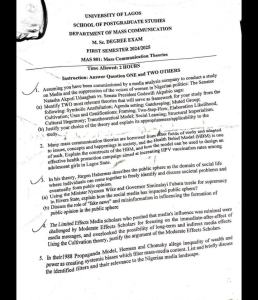
After including the high-profile political dramas between Senator Natasha Akpoti-Uduaghan and Senate President Godswill Akpabio, as well as the power struggle between Minister Nyesom Wike and Rivers State Governor Siminalayi Fubara, in a recent exam question, the University of Lagos (UNILAG) has generated a lot of online buzz.
For their first-semester exam, MSc students studying mass communication used the contentious feuds as case studies.
The university requested that students use media theories to analyze actual political conflicts in the surfaced exam question.
sIn one section of the test, students were asked to use the Natasha Akpoti-Uduaghan vs. Godswill Akpabio case study to examine how the media suppresses women’s voices in Nigerian politics.
The second part of the test asked students to evaluate the ongoing power struggle in Rivers State between Governor Siminalayi Fubara and Minister Nyesom Wike.
The full question read:
1. Assuming you have been commissioned by a media analysis company to conduct a study on Media and the suppression of the voices of women in Nigerian politics: The Senator Natasha Akpoti-Uduaghan vs. Senate President Godswill Akpabio saga;
(a) Identify TWO most relevant theories that will serve as a framework from your study of the following: Symbolic Annihilation; Agenda Setting; Gatekeeping; Muted Group; Cultivation; Uses and Gratifications; Framing; Two-step flow; Elaboration likelihood; Cultural Hegemony; Transtheoretical model; Social Learning; Structural Imperialism.
(b) Justify your choice of the theory and explain its appropriateness/applicability to the study.
3. In his theory, Jürgen Habermas describes the public sphere as the domain of social life where individuals can come together to freely identify and discuss societal problems and form public opinion.
(a) Using the Minister Nyesom Wike and Governor Siminalayi Fubara tussle for supremacy in Rivers State, explain how social media has impacted the public sphere.
(b) Discuss the role of “fake news” and information in influencing the formation of public opinion in the public sphere.
See below;
Published by Ejoh Caleb