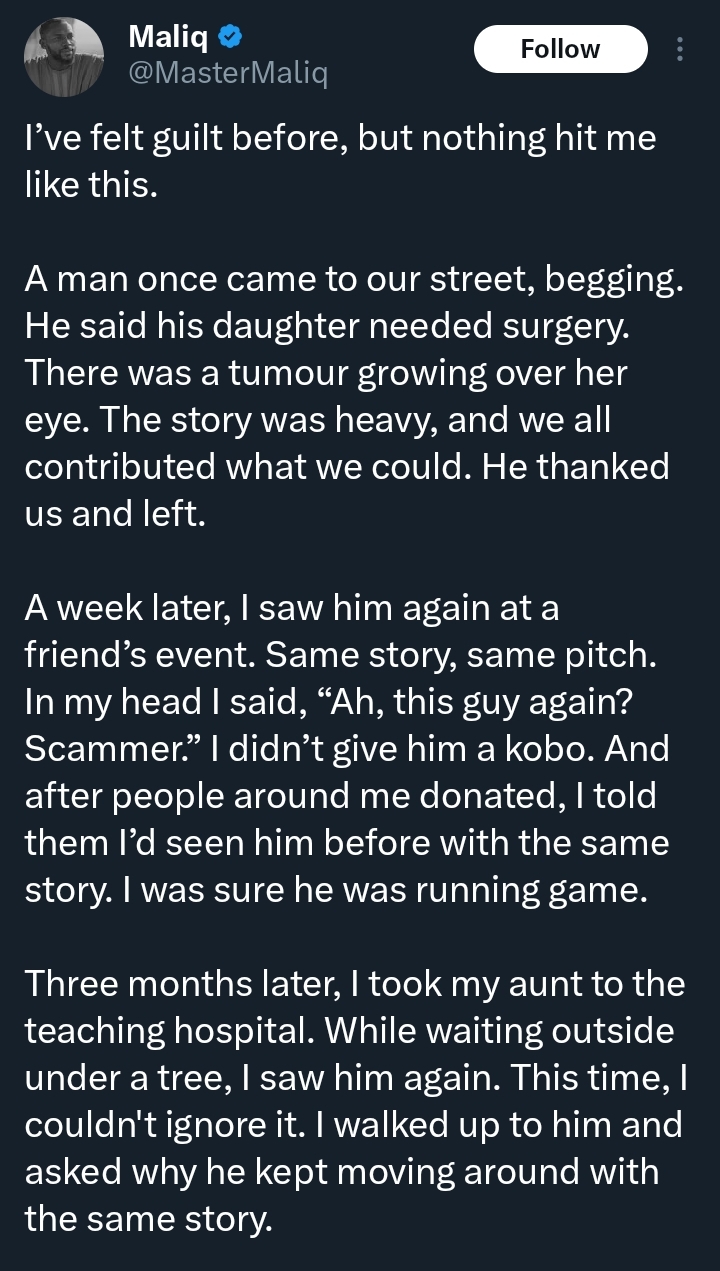
It was an experience that reshaped how I see the world and the people in it. A few months ago, a man came to my street begging for help to fund treatment for his daughter, who had a tumour growing over her eye. Moved by his story, residents contributed what they could, hoping to ease the burden on a family in desperate need.
A week later, I saw the same man at a friend’s event, repeating the same story. Skepticism crept in. I refused to give, warning others that I had heard the tale before. Surely, I thought, it had to be a scam.
But months later, life confronted me with a reality I wasn’t ready for. Accompanying my aunt to a teaching hospital, I saw the man sitting outside. Something urged me to approach him, and I asked why he kept telling the same story everywhere.
Quietly, he asked me to follow him inside the hospital. And there she was—his nine-year-old daughter lying in the children’s ward, her tumour unmistakable. I froze, overwhelmed with guilt and tears. Despite months of begging, he had barely raised 30% of the money needed for her surgery, which was only weeks away.
In that moment, I learned a painful but vital lesson: not every heartbreaking story is a lie, and not every plea for help is a scam. Some people are carrying pain that others cannot begin to imagine.
Since then, I have made a conscious choice—to respond with kindness over suspicion, even when I cannot give financially. Sometimes, the story is real.
Published by Ejoh Caleb