A Nigerian man has revealed a terrifying story of how, after becoming ill and being tricked into a car by someone who knew his name, he barely avoided becoming a victim of kidney trafficking in Gombe State.
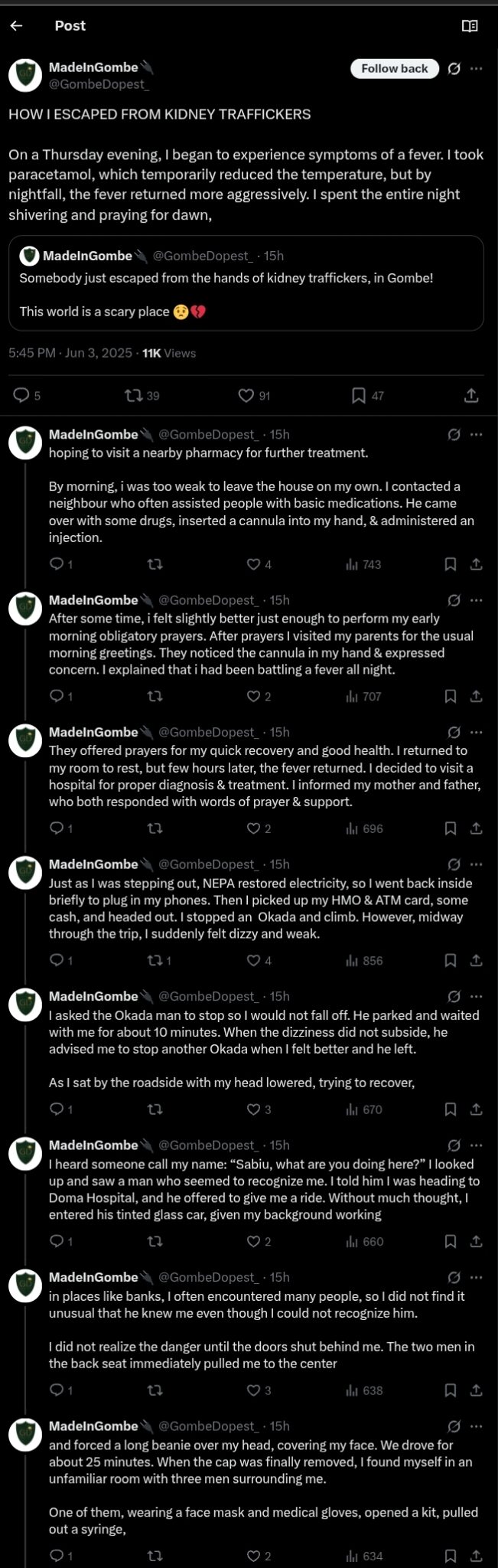
The story, shared on X (formerly Twitter) by user @GombeDopest_, describes the horrifying experience the victim, who was only known as Sabiu, had after passing out from a fever and inadvertently getting into a car with tinted windows.
The story states that on a Thursday night, Sabiu started experiencing feverish symptoms and took paracetamol, which momentarily relieved them. However, his condition deteriorated by nightfall, and he shivered through the night.
The next morning, unable to go out alone due to weakness, he called a neighbor who assisted him in giving him some medicine via a cannula.
Feeling a little better, he went to see his parents and finished his morning prayers. He reassured them he was controlling the fever and made the decision to visit the hospital later for appropriate care, despite their worries when they saw the cannula.
He retrieved his ATM card, HMO card, and some cash, plugged in his phones as soon as the power came back on, and left.
He got into an Okada (motorcycle taxi), but halfway through the ride he felt lightheaded and asked the rider to stop. After waiting for about 10 minutes without recovering, the rider advised him to rest and left.
While sitting by the roadside, a car with tinted windows pulled up. A man inside called out his name. In his frail condition, he got into the car after realizing the man might have known him from previous bank jobs.
The situation took a sinister turn a few moments later.
“The two men in the back seat pulled me to the center and forced a long beanie over my head, covering my face. We drove for about 25 minutes. When the beanie was finally removed, I found myself in a room with three men surrounding me,” He recounted.
The man, clad in a face mask and gloves, extracted his blood, collected a sample of his saliva, and requested a sample of his urine.
He was physically beaten until he obeyed when he would not. They offered him food, but he declined because he was afraid and ill with a fever.
He noted a clock on the wall: it was 11:20 a.m.
Left alone most of the day, he overheard discussions later that night about his kidney, which confirmed his worst fears.
the doctor returned and, after reviewing some documents, confirmed he was healthy aside from the fever and gave him medication that provided some relief. Despite this, Sabiu continued to reject any food or drink.
The following night, he overheard the traffickers speaking to the doctor about transporting him to Kaduna for surgery scheduled on Monday.
He also heard the driver ask about payment and the buyer of the kidney. One of them quickly realized the door had been left ajar and locked it properly, fearing he had heard too much—which he had.
Realizing his life was in danger, Sabiu knew he had to escape.
“I inspected the room. The doors and windows were secure, but the ceiling was made of a thin rubber-like material.”
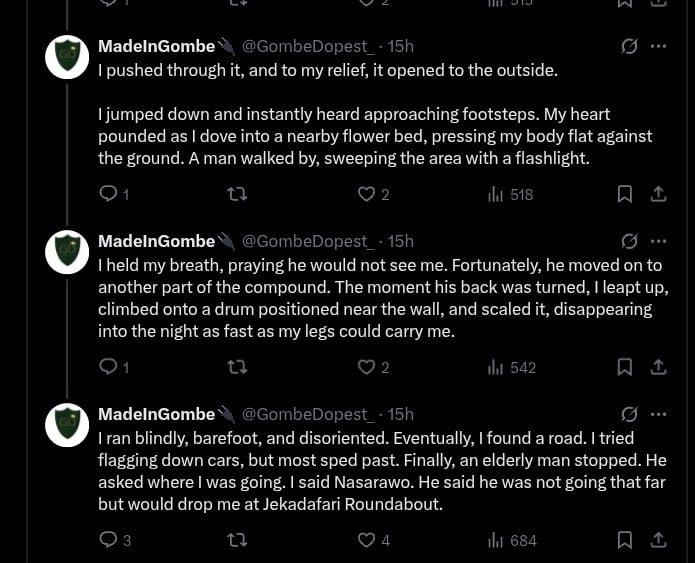
“I dragged a chair to the center of the room, climbed onto it, and broke through the ceiling. I crawled across into another room and then found a weak spot in the roof, which I forced open.”
Once outside, he hid in a flower bed as a man with a flashlight passed by. When the coast was clear, he climbed a drum near the wall and escaped the compound barefoot and disoriented.
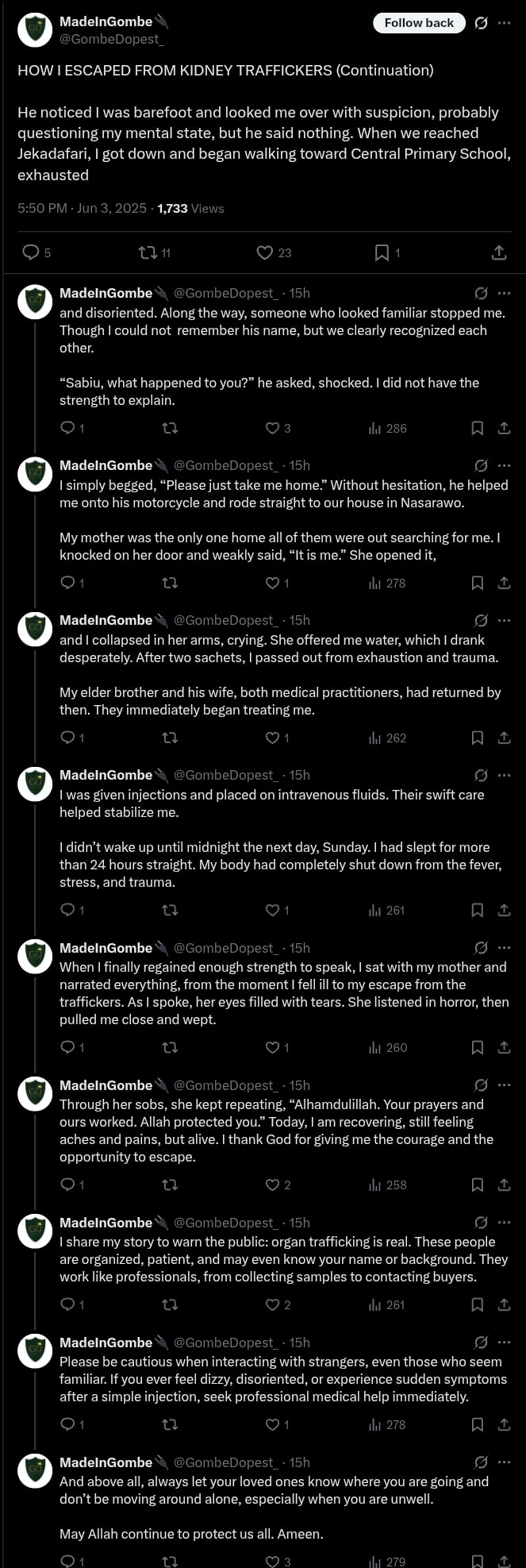
He flagged down several cars before an elderly man finally stopped and offered to drop him at Jekadafari Roundabout.
Exhausted and dazed, he walked toward Central Primary School and was recognized by a familiar face who offered to take him home.
At home, his mother was the only one in. The rest of the family had been out searching for him.
“I knocked weakly and said, ‘It’s me.’ She opened the door, and I collapsed in her arms, crying. After drinking two sachets of water, I passed out.”
His elder brother and wife—both medical professionals—returned shortly after and began treatment. He was placed on IV fluids and administered injections. Sabiu didn’t regain consciousness until midnight the following day, having slept for over 24 hours due to exhaustion and trauma.
When he finally woke up, he narrated everything to his mother, who wept and thanked God for his miraculous escape.
“I share my story to warn the public: organ trafficking is real,” he wrote.
“These people are organized and may even know your name or background. They operate like professionals—from taking medical samples to communicating with buyers.”
His story has sparked widespread concern on social media, with many Nigerians expressing shock and urging authorities to act swiftly in combating the growing threat of organ trafficking.
SEE POST: