A Nigerian lawyer has sparked reactions online after using a clever legal strategy to help his client secure written proof of a ₦300,000 debt that was previously based only on verbal agreement.
The case involved a young woman who had lent ₦300,000 to someone but had no written documentation to back up her claim. Without proof such as a signed agreement, receipt, or acknowledgment message, enforcing repayment through legal means would have been difficult.
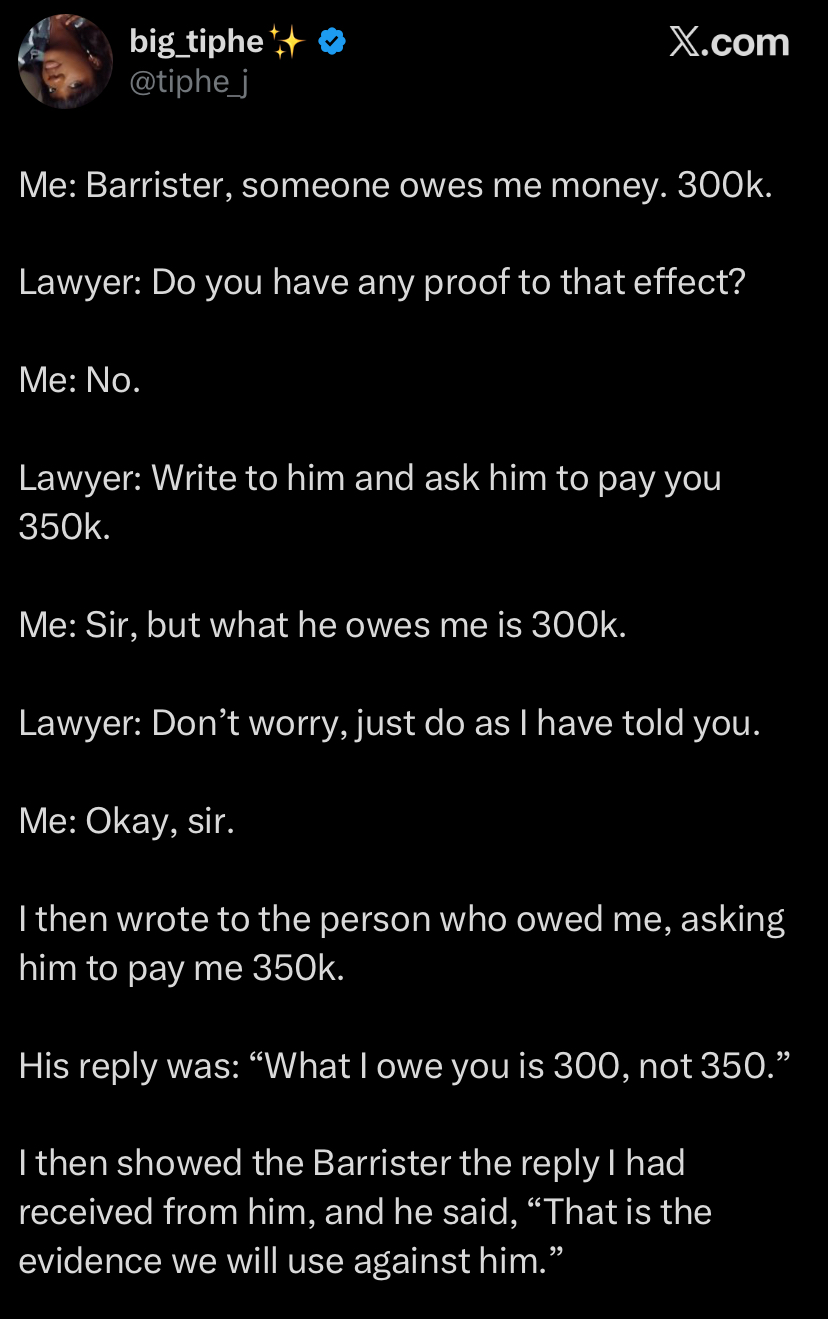
When she approached her lawyer for help, the conversation reportedly went like this:
“Sir, someone owes me money. ₦300k.”
“Do you have any proof to that effect?” the lawyer asked.
“No,” she admitted.
The Strategy
Instead of advising her to directly demand the ₦300,000 owed, the lawyer suggested a surprising move — she should ask for ₦350,000 instead.
Confused, she responded:
“Sir, but what he owes me is ₦300k.”
The lawyer reassured her and instructed her to proceed as advised.
The idea behind the strategy was simple but strategic: by inflating the amount slightly, it would likely provoke a correction from the debtor. That correction, if made in writing, could serve as an acknowledgment of the real debt.
The Debtor’s Response
When the client followed through and requested ₦350,000, the debtor replied:
“What I owe you is 300, not 350.”
That single sentence became the breakthrough.
By correcting the amount in writing, the debtor inadvertently confirmed that he indeed owed ₦300,000. This written acknowledgment could now serve as admissible evidence in a legal claim for debt recovery.
“I then showed the Barrister the reply I had received from him, and he said, ‘That is the evidence we will use against him.’”
Why This Works Legally
In many legal systems, including Nigeria’s, a written acknowledgment of debt — even via text message or social media chat — can be used as evidence in court. Once a debtor admits owing a specific amount, it significantly strengthens the creditor’s case.
The lawyer’s approach effectively transformed a purely verbal agreement into documented proof without confrontation or direct accusation.
The story has since gone viral, with many praising the lawyer’s ingenuity and others describing it as a valuable lesson on always documenting financial transactions.
Lesson learned: Always have written agreements when lending money — but if you don’t, sometimes strategy can save the day.
See below;
Published by Ejoh Caleb