
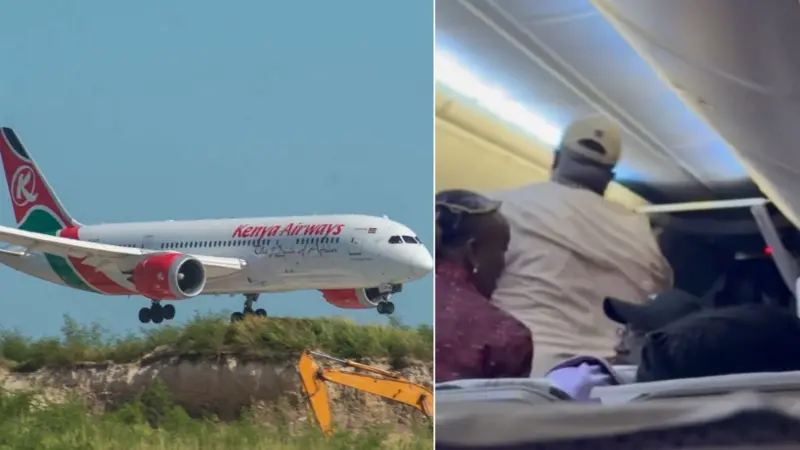
A passenger has died on a Kenya Airways flight from Nairobi to Lagos. Early online posts said he died after trying to open a cabin door in the air. The official accounts are more limited, and they differ on how the death came about. We found no confirmed cause of death.
What the airline says (a medical emergency)
Kenya Airways confirmed that on Tuesday, October 6, 2026, its flight from Nairobi to Lagos had a medical emergency on board at about 9:20 p.m. Nigerian time. A passenger was found unresponsive about 20 minutes before landing. The aircraft landed at Murtotala Muhammed International Airport at 9:41 p.m., and medical staff on the ground confirmed that the passenger had died. The airline said its crew gave first aid and followed emergency procedures. It also said it was working with the family, local authorities and aviation regulators, and that it respects the privacy of those involved. The airline did not name the passenger or say what caused the emergency.
What Nigerian officials say (the claims about behaviour)
An official of the Nigeria Civil Aviation Authority (NCAA), Achimugu, said the passenger was being returned after customs authorities in Madagascar refused him entry. He said the man became restless and aggressive during the flight. He alleged that he tried to enter the cockpit, and later tried to open the rear door. The official added that the man was “tied down,” and a report said his hands were tied behind his back to protect other passengers and the crew.
The spokesperson of the Airport Command of the Nigeria Police Force, Adeola Muhammed, said the case involved an “inadmissible passenger” and that complications arose on the return flight. The police have taken over the investigation.
An inadmissible passenger is someone whom a country’s authorities refuse to let enter. The airline that carried the person must usually take him back.
What is not known (the gaps)
The airline’s statement does not mention any door attempt. The claims about the cockpit and rear door come from a Nigerian official and from passengers’ videos, and the airline has not confirmed them. Several things remain unclear: the man’s identity, his health, how long he was restrained, whether the restraint played any part, and what caused his death. An autopsy and the police investigation should answer these questions. Until then, it is wrong to say that he died because he tried to open a door.
One passenger told a blog that the man was already aggressive before boarding and should not have been allowed on the flight. That is one passenger’s view, and it has not been confirmed.
Can a passenger really open a plane door in flight? (what experts say)
No. At cruising height, the difference in air pressure between the cabin and the outside holds the doors shut, and modern doors also have locking systems. Business Insider has noted that opening one in midair is effectively impossible. That is why such attempts are dangerous mainly for the people who try to stop them, and for the fear they cause.
Other flights, other disruptions (past cases)
Attempts to open doors in flight have happened elsewhere. On a Plus Ultra flight from Madrid to Caracas, a flight attendant fractured his leg while stopping a passenger who tried to open an emergency exit. In an earlier case in India, an IndiGo passenger who tried to open an emergency door was detained after the plane landed, and officials said legal action would follow. In both cases, the aircraft landed safely.
A closer lesson comes from a death after restraint. In October 2010, Jimmy Mubenga, an Angolan man being deported from the UK, died after being restrained by security guards on a British Airways flight. An inquest jury ruled in 2013 that he was unlawfully killed. In December 2014, three G4S guards were found not guilty of manslaughter. That case is not the same as this one, and nothing yet shows that restraint caused this death. But it shows why deaths of restrained passengers need careful, open investigation.
Fear in the air, and a hard task for crew (what may lie behind such incidents)
Disruptive behaviour on flights can come from many things, such as fear, intoxication, a mental health crisis, a medical problem or the stress of being refused entry and sent back. Crew must act quickly, because a person trying to enter a cockpit or open a door is a safety risk. But restraint carries its own risks, especially if a person’s breathing is restricted or if he has an underlying health problem.
The case also raises a question about how inadmissible passengers are screened and escorted before and during a flight.
Trauma for passengers and questions for airlines (effects)
Other passengers were reportedly thrown into panic, and some shared videos. That experience can be frightening and lasting. For the dead man’s family, the first need is to know what happened to him.
For the aviation industry, the case tests how airlines and authorities handle people who are returned from other countries. For Nigeria, it is a test of how openly the police and the NCAA report the findings.
Clear answers and safer handling (possible solutions)
The police should carry out a thorough investigation, including an autopsy and interviews with crew and passengers, and make the findings public. Kenya Airways should explain what happened on board, including whether the passenger was restrained and for how long.
For the future, airlines and border authorities can improve how they screen, escort and medically assess inadmissible passengers, and train crew in safe restraint and in handling a person in distress. Authorities should set clear rules on who is responsible for such passengers. Families should receive support and information, and passengers who filmed events should give their footage to investigators.
Facts first, then fairness (our view)
We offer our condolences to the passenger’s family. A man has died, and we do not yet know why.
We urge caution on both sides. It would be wrong to assume that he caused his own death by trying to open a door, since the airline has said only that there was a medical emergency. It would also be wrong to assume that the crew did anything improper, since we do not know. What the public needs is a clear account, backed by medical evidence. If the investigation is open and thorough, it can protect other passengers, other crews and anyone who might one day be returned on a flight like this.
Published by Ejoh Caleb