
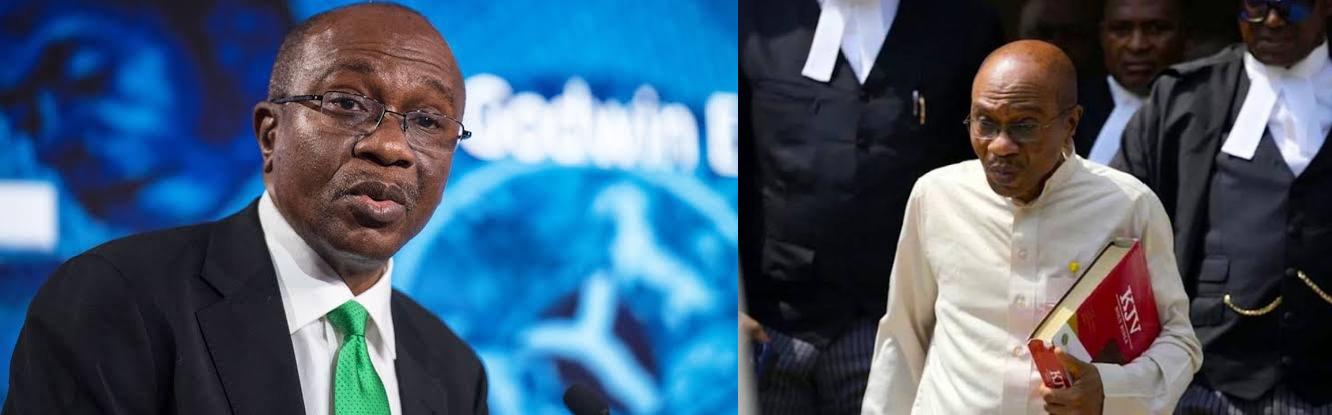
The Supreme Court has permanently stripped former Central Bank of Nigeria (CBN) Governor Godwin Emefiele of seven luxury properties, over $2 million in cash, and share certificates, closing out one of Nigeria’s highest-profile asset recovery battles and sending a fresh signal about how far the country’s anti-corruption fight is willing to go against its own former power brokers.
What the Apex Court (Supreme Court, Nigeria’s Highest Court) Ruled
In a unanimous judgment delivered on Friday, July 17, 2026, a five-member Supreme Court panel led by Justice Ibrahim Saulawa overturned a Court of Appeal ruling that had thrown out the forfeiture order and demanded a fresh trial. The judgment, read by Justice Mohammed Idris, restored the November 1, 2024 decision of Federal High Court Justice Deinde Dipeolu, which had found that the assets were reasonably suspected to be proceeds of unlawful activity.
The Economic and Financial Crimes Commission (EFCC), the agency that led the case, was represented by a legal team including former Attorney-General of the Federation Kanu Agabi (SAN) and the Director of Public Prosecutions of the Federation, Rotimi Oyedepo (SAN). Emefiele was represented by Senior Advocates of Nigeria Olalekan Ojo and Labi Lawal. The forfeited assets include two detached duplexes on Hakeem Odumosu Street in Lekki Phase 1, Lagos, an undeveloped plot on Oyinkan Abayomi Drive in Ikoyi, a bungalow on the same street, and share certificates tied to Queensdorf Global Fund Limited Trust. The Federal High Court had earlier held that Emefiele failed to prove his CBN and Zenith Bank earnings were legitimately used to acquire the properties, and that the companies listed as owners never came forward to claim them.
Not His First Forfeiture, and Not an Isolated Case (Past Precedents)
This is not the first major asset recovery ruling tied to Emefiele. In December 2024, the EFCC separately obtained final forfeiture of a 753-unit housing estate spanning 150,500 square metres in the Lokogoma district of Abuja, also linked to the former CBN governor; the Federal Government formally took over that estate in May 2025.
The Emefiele case also fits a fast-moving pattern this month alone. On Wednesday, July 15, 2026, Justice Joyce Abdulmalik of the Federal High Court in Abuja ordered the final forfeiture of 48 properties worth roughly N213 billion linked to former Attorney-General of the Federation and Minister of Justice Abubakar Malami, including hotels, a university, and malls across Abuja, Kaduna, Kano and Kebbi State. The judge’s reasoning mirrored the standard applied to Emefiele: “The issue before this court is not who owns the property, but how legitimate the funds used to acquire the property are.” Under Nigeria’s non-conviction-based forfeiture law, prosecutors only need to establish reasonable suspicion, after which the burden shifts to the property owner to prove the money was clean.
A third case shows how these battles can drag on for years and take unexpected turns. Former Minister of Petroleum Resources Diezani Alison-Madueke had over 80 properties and $153 million in assets forfeited following a 2022 Federal High Court order, according to then-EFCC chairman Abdulrasheed Bawa. She has spent years in court challenging the sale of those assets, and in a notable twist, was acquitted of separate bribery charges by a UK court, the Southwark Crown Court, on June 17, 2026, a verdict her lawyers are now trying to introduce as evidence in her ongoing Nigerian asset forfeiture case. Her case is a reminder that not every high-profile forfeiture proceeds as smoothly or finally as the Emefiele ruling did this week.
Why This Case Matters Beyond One Man’s Wealth (Causes and Effects)
It tests whether due process protects the powerful differently. Emefiele’s legal team spent over a year fighting the forfeiture through the appellate courts; the Supreme Court’s decision affirms that even a former central bank governor cannot indefinitely delay enforcement once a court is satisfied assets are suspicious.
It strengthens the EFCC’s institutional standing. A Supreme Court win, as opposed to a High Court or Court of Appeal ruling that can still be challenged, gives the anti-graft agency a much stronger legal precedent to cite in future asset recovery cases against other former officials.
It reinforces Nigeria’s post-FATF grey list reform story. Nigeria was removed from the Financial Action Task Force’s grey list of countries under increased money-laundering monitoring on October 24, 2025, after a two-year, 19-point reform programme. High-profile, court-tested asset recoveries like this one are part of what international observers point to as evidence that Nigeria’s anti-money laundering enforcement is more than paperwork.
It affects public trust domestically. For ordinary Nigerians who have watched successive administrations promise to recover looted wealth without visible results, a Supreme Court-affirmed forfeiture is a rare, concrete outcome rather than another announcement.
Why is this specific case significant?
It’s the first time this particular battle reached a definitive end. Emefiele fought the forfeiture for over a year, won a reversal at the Court of Appeal in June 2025, and could easily have dragged this out further. A unanimous Supreme Court ruling closes that door completely — there’s no higher court left to appeal to. It’s also significant because Emefiele wasn’t just any official; he ran the institution meant to safeguard Nigeria’s monetary system for nearly a decade. A former CBN Governor losing a Supreme Court fight over unexplained wealth is a different order of symbolism than a lower-profile official losing the same fight.
What does this reveal about the corruption nature of top government agents?
A few things stand out from the pattern across Emefiele, Malami, and Diezani:
Scale and sophistication. These aren’t small bribes — Malami’s case alone involved 48 properties worth ~N213 billion, spanning hotels, a university, and companies across four states. That level of asset diversification suggests deliberate structuring to obscure ownership, not opportunistic corruption.
Reliance on proxies and shell entities. In Emefiele’s case, the properties were held through companies and a trust (Queensdorf Global Fund) that never came forward to claim ownership — a common laundering pattern where officials use corporate vehicles to distance themselves from assets on paper.
It’s systemic, not incidental. Three of Nigeria’s most powerful institutions — the Central Bank, the Ministry of Justice/AGF office, and the Petroleum Ministry — have each had a top former official face major forfeiture. That’s not a coincidence of individual greed; it points to weak internal controls and oversight at the exact institutions meant to prevent this.
Impunity depends on how long you can litigate. Diezani’s case, still unresolved after roughly a decade, shows that wealth and legal access can stall consequences almost indefinitely, even after asset forfeiture is ordered.
What are the wider implications for Nigeria and internationally?
Domestically, it tests whether Nigeria’s courts will consistently enforce forfeiture orders against the politically powerful, rather than let appeals wear cases down over years. It also raises the accountability question of what happens after forfeiture — Nigeria doesn’t have a strong public track record of transparently showing how recovered assets are used.
Internationally, the timing matters: Nigeria only exited the FATF grey list in October 2025 after a two-year reform push. High-profile, court-tested enforcement actions like this one are exactly the kind of evidence foreign regulators, banks, and investors look for to decide whether Nigeria’s reforms are real or just paperwork. A steady stream of these rulings supports that credibility; any reversal or indefinite stalling (like Diezani’s case) undercuts it.
The Wider Cost and Opportunity for Nigeria and the World (National and Global Effects)
Domestically, successful, court-tested forfeitures like this one matter for more than optics. Recovered assets, once liquidated or repurposed, can fund public infrastructure or social programmes, though Nigeria has a mixed record on transparently tracking what happens to recovered funds after forfeiture. The ruling also puts other former officials facing similar EFCC cases on notice that the courts, right up to the Supreme Court, are willing to uphold asset recovery orders even after lengthy appeals.
Internationally, this ruling arrives at a moment when Nigeria is trying to consolidate the credibility it gained from exiting the FATF grey list. Analysts have noted that Nigeria’s reform story is now being used to position the country as a rule-setter for financial compliance across African fintech and banking. Visible, high-value enforcement actions like the Emefiele and Malami forfeitures give that narrative something concrete to point to, beyond legislative reform documents, when foreign investors and financial partners assess how seriously Nigeria treats corruption within its own former leadership.
What This Means Going Forward (Possible Implications)
Other pending EFCC cases involving former officials may move faster now that the Supreme Court has set a clear precedent on this type of “unexplained wealth” forfeiture.
Transparency in how recovered assets are used remains the next test; the public will be watching whether the properties and funds are properly accounted for once they pass to the Federal Government.
Legal reform advocates may push for faster resolution timelines in future asset recovery cases, given how long the Emefiele case took to move from High Court to Supreme Court.
Nigeria’s international financial standing stands to benefit further if enforcement actions like this one continue at the current pace, reinforcing the credibility built since the FATF grey list exit.
My Thoughts
What strikes me about this ruling is not just the size of what was recovered, but how long it took, and how close it came to being reversed entirely at the Court of Appeal. That should worry anyone counting on Nigeria’s courts to move quickly and consistently against corruption. Still, a unanimous Supreme Court decision restoring the forfeiture is a meaningful outcome, especially coming in the same week as a similar ruling against a former Attorney-General. If this pace continues, it could genuinely shift how Nigerians and the wider world view the country’s willingness to hold its own former power brokers accountable. But rulings alone don’t rebuild trust. What happens to these properties and funds next, and whether ordinary Nigerians ever see any benefit from them, is what will really determine whether this moment becomes a turning point or just another headline.
Published by Ejoh Caleb