

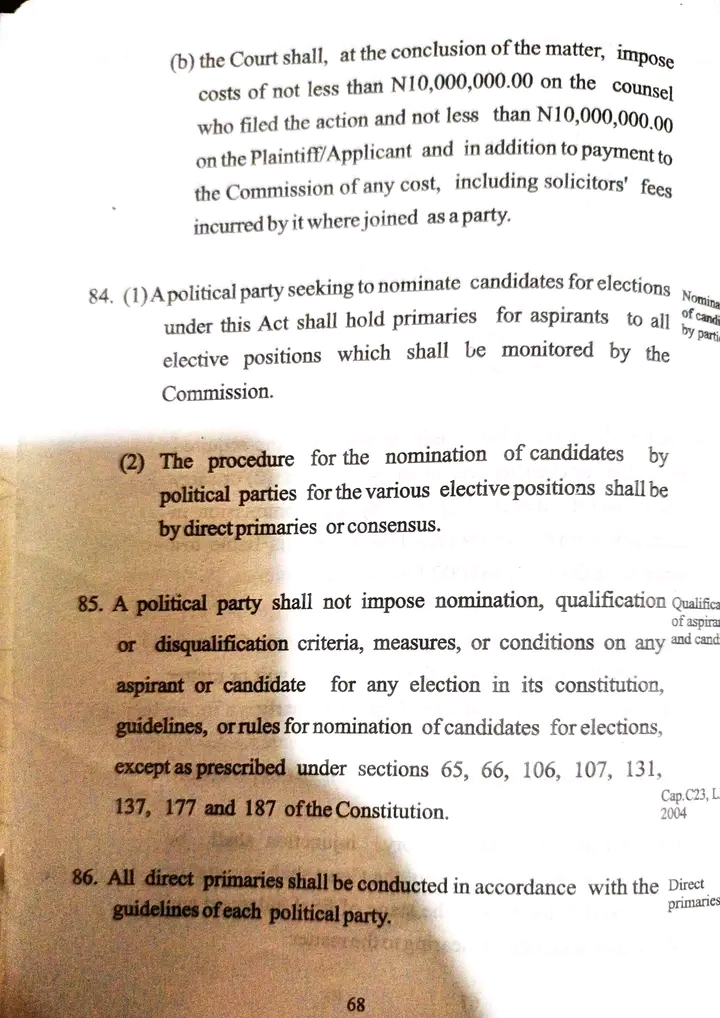
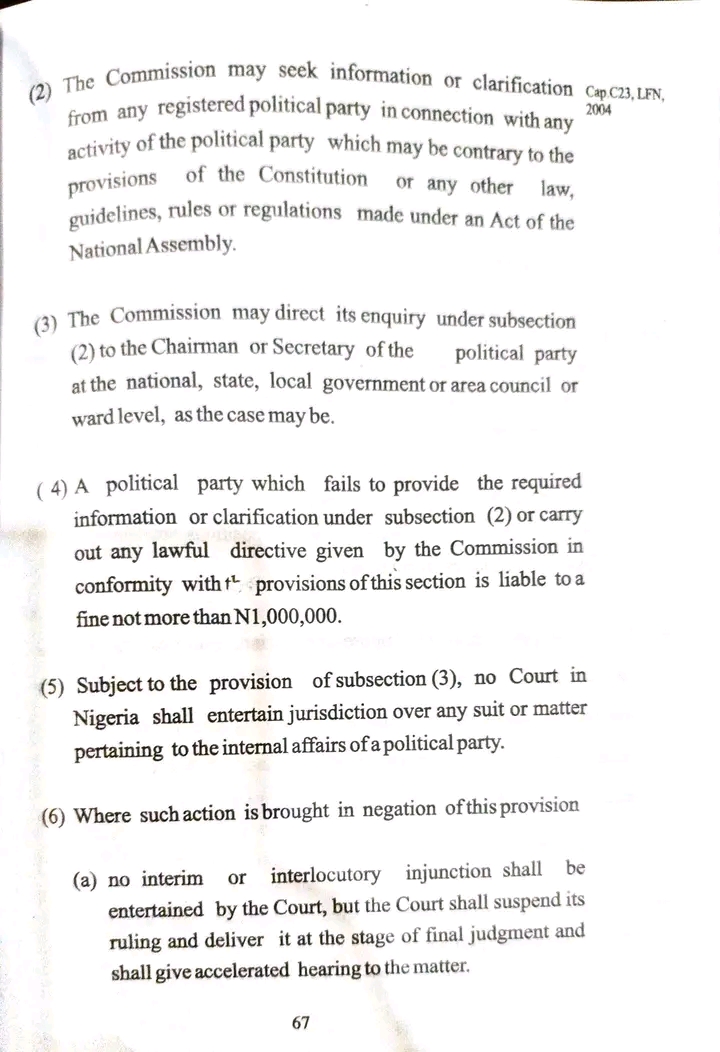
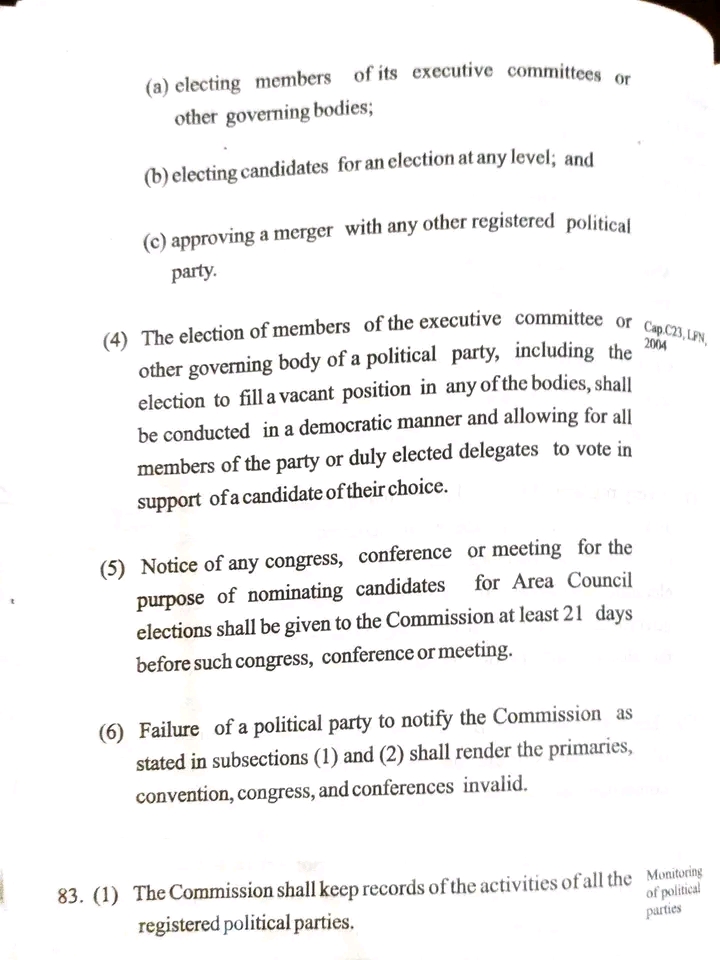
Below are the provisions of Section 83 of the Electoral Act, 2026, recently signed into law. Particular attention is drawn to subsections (5) and (6), which were widely seen as deliberate safeguards introduced by legislators—politicians themselves—to protect political parties from being destabilised by excessive litigation and intrusive court orders.
These provisions appear designed to prevent situations where internal party disputes are constantly escalated into court, leading to paralysis in party administration and governance. The intent, on its face, is to preserve internal party stability and reduce judicial interference in purely organisational matters.
However, a deeper concern arises from the practical enforcement of these rules. In Nigeria’s experience, it is often the courts themselves—tasked with interpreting and enforcing the law—that end up creating the very instability the law seeks to prevent. Through expansive or premature interim orders, particularly “status quo” directives, judicial decisions can sometimes override the spirit of legislative intent before the substantive issues are even determined.
This raises a critical question: how should courts balance the need to preserve subject matter in urgent cases against the risk of effectively determining political outcomes at an interlocutory stage?
A recent example is the Court of Appeal’s “status quo” order in a dispute involving the ADC, initiated by a single party member. Critics argue that such an order may have crossed the boundary of judicial restraint, effectively disrupting the protections embedded in the Electoral Act before it could properly take effect.
This development has triggered broader reflections on the role of the judiciary in Nigeria’s democratic and political processes. Some argue that such interventions contribute to a growing perception of unpredictability in the legal system, where outcomes depend less on clear statutory rules and more on discretionary judicial action.
At a deeper level, the concern being raised is not only about one case, but about a pattern: the tendency for institutions of authority to prioritise control over consistent adherence to norms. When rules are applied inconsistently or overridden in the name of justice, it can create uncertainty about the reliability of law as a framework for ordering political and social life.
Ultimately, the issue speaks to a larger national tension between legal order and institutional discretion. The fear expressed by critics is that repeated judicial intervention in intra-party disputes may weaken confidence in the stability of electoral rules and contribute to a broader sense of unpredictability in governance.
Whether this represents necessary judicial protection or excessive interference remains the central question.

Published by Chuks Nwachuku