
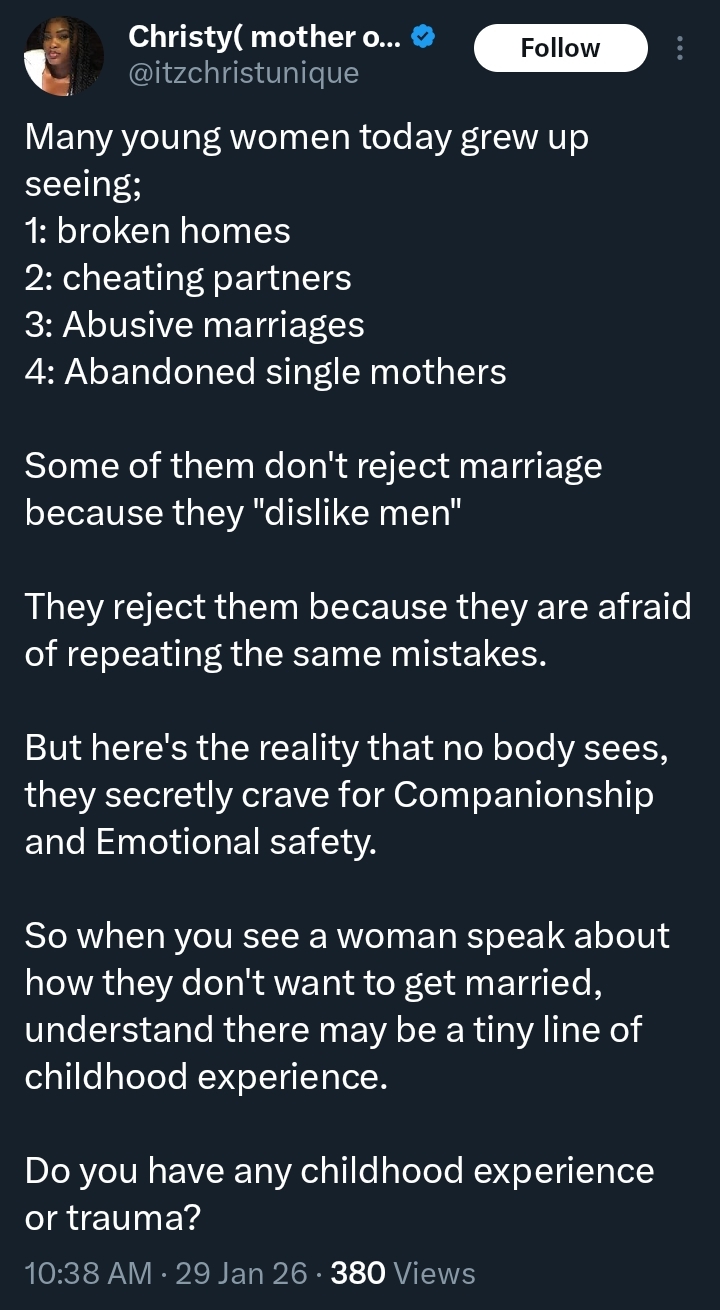
A widely shared post on X (formerly Twitter) has reignited conversations about why many young women express fear or hesitation toward marriage, pointing to the lasting influence of childhood experiences rather than a rejection of love or men.
The viral post argues that many women grew up witnessing broken homes, infidelity, abusive relationships, and the struggles of abandoned single mothers. According to the writer, these early exposures leave deep emotional imprints that shape how women perceive marriage in adulthood.
Rather than seeing marriage as a safe partnership, the post suggests that some women associate it with pain, instability, and emotional trauma. As a result, when women publicly say they do not want to get married, it may not be rooted in dislike for commitment but in fear of repeating the patterns they observed growing up.
The writer explains that these fears often create an internal conflict — a longing for companionship and emotional security on one side, and the fear of vulnerability and heartbreak on the other. This emotional tension, the post claims, is why some women appear resistant to marriage despite still desiring love and connection.
The message concludes by urging empathy, encouraging people to look beyond surface statements and consider the unseen childhood experiences that influence adult choices about relationships, love, and commitment.
Public Reactions
The post sparked intense reactions online, with users offering differing perspectives.
Walter wrote:
“The tragedy is that they are fighting a civil war between their biology and their memory. I want a companion and a protector. But the protector is the predator. They will often sabotage a good man just to prove their internal bias that marriage fails. Deep down, they would rather be right and lonely than vulnerable and hurt.”
Gift shared a more sympathetic view, saying:
“Many women don’t reject marriage because they hate love, but because they fear repeating the pain they saw growing up.”
However, Adeleke questioned the gender focus of the argument, writing:
“Do you think it is only women who experience this alone? Are men immune to this? I am trying to understand as well.”
The debate continues to trend online, highlighting broader conversations around trauma, trust, gender expectations, and how childhood experiences shape adult relationships.
Published by Ejoh Caleb